LLMs arrived in 2023. It’s now 2026.
And the majority of e-commerce brands still have no LLM visibility strategy.
Not a weak one. Not a work-in-progress one. Zero.
This isn’t an opinion. I can prove it with one report from Google Analytics.
What Zero Looks Like
A brand I recently audited had been operating in the US pet market for years. Revenue was stagnant. They had a content team, an email program, and an SEO strategy — or at least the beginnings of one. On Google the picture wasn’t much better: dog treats alone drew 110,000 monthly searches and sent them 4 clicks in 90 days. I worked out what that costs in The Cost of Inaction.
When I pulled AI/LLM channel data from Google Analytics for January through June 2025, here’s what I found:
- ChatGPT: 76 sessions. $114 in revenue.
- Perplexity: ~10 sessions. $34 in revenue.
- All other AI sources: Effectively zero.
$148 in total AI-driven revenue over six months, in a $34.6 billion market.
When I mentioned this to the team, someone pulled up an internal document that referenced “optimising for agentic commerce” and “revenue through multiple LLMs.”
The attribution data said otherwise — which is exactly why it’s the first thing I ask for in any growth audit.
Key Takeaways
- In one audit of a US pet-market brand, Google Analytics showed $148 in AI-driven revenue over six months (ChatGPT: 76 sessions, $114; Perplexity: ~10 sessions, $34) in a $34.6 billion market, even though internal documents claimed revenue “through multiple LLMs.”
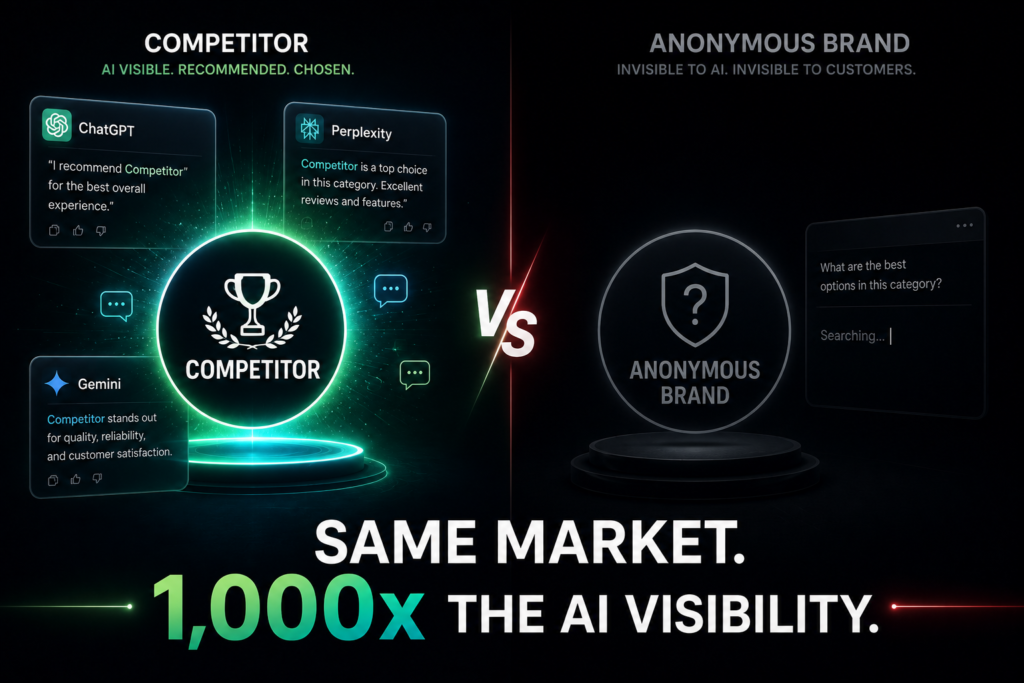
- The gap reinforces itself: the channel isn’t tracked, so it’s left out of strategy, so nothing gets built, so the numbers stay near zero. In that category, the leaders were pulling roughly 1,000x more AI sessions.
- In agentic commerce, the AI gives a direct recommendation instead of ten blue links. If your brand isn’t in its training data, in the sources it trusts, or in real-time retrieval, you don’t exist in that answer.
- LLMs weigh different signals than Google: mentions in authoritative third-party sources, fact-dense content, structured product data, and consistent brand mentions across the web.
- Three levers move it: third-party citations, cite-able content, and schema for products and reviews (plus visible FAQs). You can audit where you stand in four steps, starting with GA4.
Why This Gap Exists
Most brands aren’t ignoring LLM visibility out of laziness. They’re caught in a familiar trap: the channel doesn’t appear in their dashboard because they haven’t set it up to be tracked, so it doesn’t get included in strategy conversations, so nothing gets built, so the numbers stay near-zero, confirming the (wrong) belief that AI channels aren’t relevant yet.
It’s a self-reinforcing blind spot.
Meanwhile, competitors who started building LLM visibility in 2023 and 2024 are now reaping the benefit. In the pet category I analysed, the gap between the brand I was auditing and category leaders on AI channels was roughly 1,000x. Not 10%. Not 5x. A thousand times more sessions.
What Agentic Commerce Actually Means
The term gets thrown around in strategy decks, but here’s what it means in practice:
A consumer opens Perplexity, ChatGPT, or an AI-native browser and asks:
“What’s the best natural dog food for a senior golden retriever that has joint issues?”
The AI doesn’t return a list of ten blue links. It generates a direct recommendation — with a brand name, a product, and sometimes a purchase link.
If your brand isn’t in the training data, in authoritative sources the LLM references, or surfaced in real-time web retrieval, you don’t exist in that response.
The consumer never types your URL. Never sees your ad. Never arrives at your SEO-optimised page. The funnel starts and ends inside the AI interface.
This is agentic commerce. And the window to become part of it — before it’s saturated and expensive — is closing. Chrome has since started measuring whether sites are ready for it. I ran the new audit on my own site in I Argued With a Founder About Agentic Commerce.
How LLMs Decide What to Recommend
This is where GEO (Generative Engine Optimisation) differs from traditional SEO.
In Google search, ranking is driven primarily by:
- Backlink authority
- On-page relevance signals
- Behavioural data (clicks, dwell time)
In LLM recommendation, the factors shift toward:
- Presence in authoritative third-party sources — LLMs are trained on and retrieve from sites like Reddit, review platforms, editorial publications, and expert blogs. If these sources don’t mention your brand, you’re invisible.
- Factual density and specificity of your own content — LLMs favour content they can cite and quote precisely. Vague marketing copy gets ignored. Specific product claims, certifications, and ingredient data get cited.
- Schema markup and structured product data — AI shopping agents parse structured data to extract product attributes. If your product pages don’t use schema, agents can’t read them reliably.
- Brand mentions across the open web — Consistency and volume of brand mentions signals to retrieval-augmented models that your brand is real, credible, and relevant.
The Three Levers That Move the Needle
Based on what I’ve seen work across clients and what the emerging research on GEO shows:
1. Authoritative third-party citations This means actively building your brand’s presence on sites LLMs prioritise: review aggregators, Reddit communities, editorial coverage, veterinary or expert blogs (in the pet category), and niche publications. A press mention on a domain-authority-80+ site is worth more for LLM visibility than 20 blog posts on your own domain.
2. Fact-dense, cite-able content Rewrite your key product and category pages to be LLM-friendly. That means specific claims backed by data, ingredient or component transparency, expert attribution where possible, and clear structured formatting (headers, lists, tables) that AI can parse and extract. Thin category pages are one of the first things I flag in a technical audit. It’s the “No Authoritative Content” issue in the C.R.A.W.L. Audit.
3. Schema markup for products and reviews, plus visible FAQs At minimum: Product schema with full attribute coverage (price, availability, brand, description, reviews) and Review schema with aggregate ratings. On category and content pages, add a plain, visible FAQ section rather than relying on FAQ schema. Google has limited FAQ rich results to well-known government and health sites since August 2023, but clear question-and-answer text is still easy for AI to parse and cite. These don’t just help Google — they help AI agents retrieve and surface your products accurately.
How to Audit Your Current LLM Visibility
Step 1 — Check your analytics In GA4, go to Acquisition → Traffic Acquisition. Look for chatgpt.com, perplexity.ai, copilot.microsoft.com, and similar referral sources. What do you see?
Step 2 — Test brand queries in ChatGPT and Perplexity Ask each: “What are the best [your product category] brands?” and “Tell me about [your brand name].” Note whether you appear, what’s said, and how accurate it is.
Step 3 — Audit your third-party presence Search your brand name + category on Reddit, review platforms, and major editorial sites. Sparse results = low LLM reference material = low visibility.
Step 4 — Check your schema implementation Use Google’s Rich Results Test and Schema Markup Validator on your top product pages. Missing or incomplete schema is a quick fix with a meaningful impact. Just don’t treat it as a launch task you tick off once. Like the rest of AI discoverability, it’s part of why a site can be finished, but not optimized.
The Window Is Open. For Now.
Every major channel in digital marketing follows the same pattern: early movers build an advantage, then it becomes expensive and crowded.
Google Ads in 2003. Facebook Ads in 2012. Google SEO has been competitive for 15 years and still requires significant investment to compete.
LLM visibility is where Google Ads was in 2004. The brands that build it now will hold an advantage that’s difficult to replicate in 18 months.
The brands that wait will spend years and budgets trying to close a gap that didn’t need to exist.
At a Glance: The Four-Step LLM Visibility Audit
| Step | Where to look | What you’re checking | Warning sign |
|---|---|---|---|
| 1. Analytics | GA4 → Acquisition → Traffic Acquisition | Sessions and revenue from chatgpt.com, perplexity.ai, copilot.microsoft.com | Near-zero AI sessions (the pet brand: $148 in six months) |
| 2. Brand queries | ChatGPT and Perplexity | “What are the best [category] brands?” and “Tell me about [brand]”: do you appear, what’s said, is it accurate? | You’re missing, or the answer is wrong |
| 3. Third-party presence | Reddit, review platforms, major editorial sites | Brand + category mentions | Sparse results = little for LLMs to reference |
| 4. Schema | Google’s Rich Results Test, Schema Markup Validator | Structured data on your top product pages | Missing or incomplete schema |
Frequently Asked Questions
It’s the distance between how much a brand thinks it shows up in AI search and how much it actually does. In one audit, a pet brand had internal documents about “revenue through multiple LLMs,” but Google Analytics showed $148 in AI-driven revenue over six months. Category leaders were getting roughly 1,000x more AI sessions.
In GA4, go to Acquisition → Traffic Acquisition and look for referral sources like chatgpt.com, perplexity.ai and copilot.microsoft.com. Then ask ChatGPT and Perplexity “What are the best [your category] brands?” and “Tell me about [your brand],” and note whether you appear and how accurate the answer is.
Google ranking is driven mainly by backlink authority, on-page relevance and behavioural data like clicks and dwell time. Generative Engine Optimisation shifts the weight toward mentions in authoritative third-party sources, fact-dense content that can be quoted precisely, structured product data, and consistent brand mentions across the open web.
A shopper asks an AI assistant or AI-native browser for a recommendation, and the AI answers directly with a brand, a product and sometimes a purchase link. The shopper never types your URL, sees your ad or lands on your SEO page. The funnel starts and ends inside the AI interface.
Yes. AI shopping agents parse structured data to pull out product attributes, so product pages without schema are hard for them to read reliably. Start with Product schema covering price, availability, brand, description and reviews, plus Review schema with aggregate ratings. Check it with Google’s Rich Results Test and the Schema Markup Validator.
No, but the window is closing. LLM visibility is roughly where Google Ads was in 2004: early movers build an advantage before the channel gets crowded and expensive. Brands that start now can hold an edge that’s hard to copy in 18 months. Brands that wait will spend years closing the gap.
I help brands build growth strategies that account for where search is going, not just where it’s been. Currently open to new opportunities in growth marketing, digital strategy, and AI-driven marketing. If your team is thinking about LLM visibility and needs someone who understands the data — connect with me on LinkedIn or reach out at harish@psharish.com.
By PS Harish
31 July 2026Comments
No comments yet.


Leave A Comment