At a glance
- AI search engines such as ChatGPT, Perplexity, Gemini and Google AI Overviews depend on the same crawl, render and index foundations as classic search.
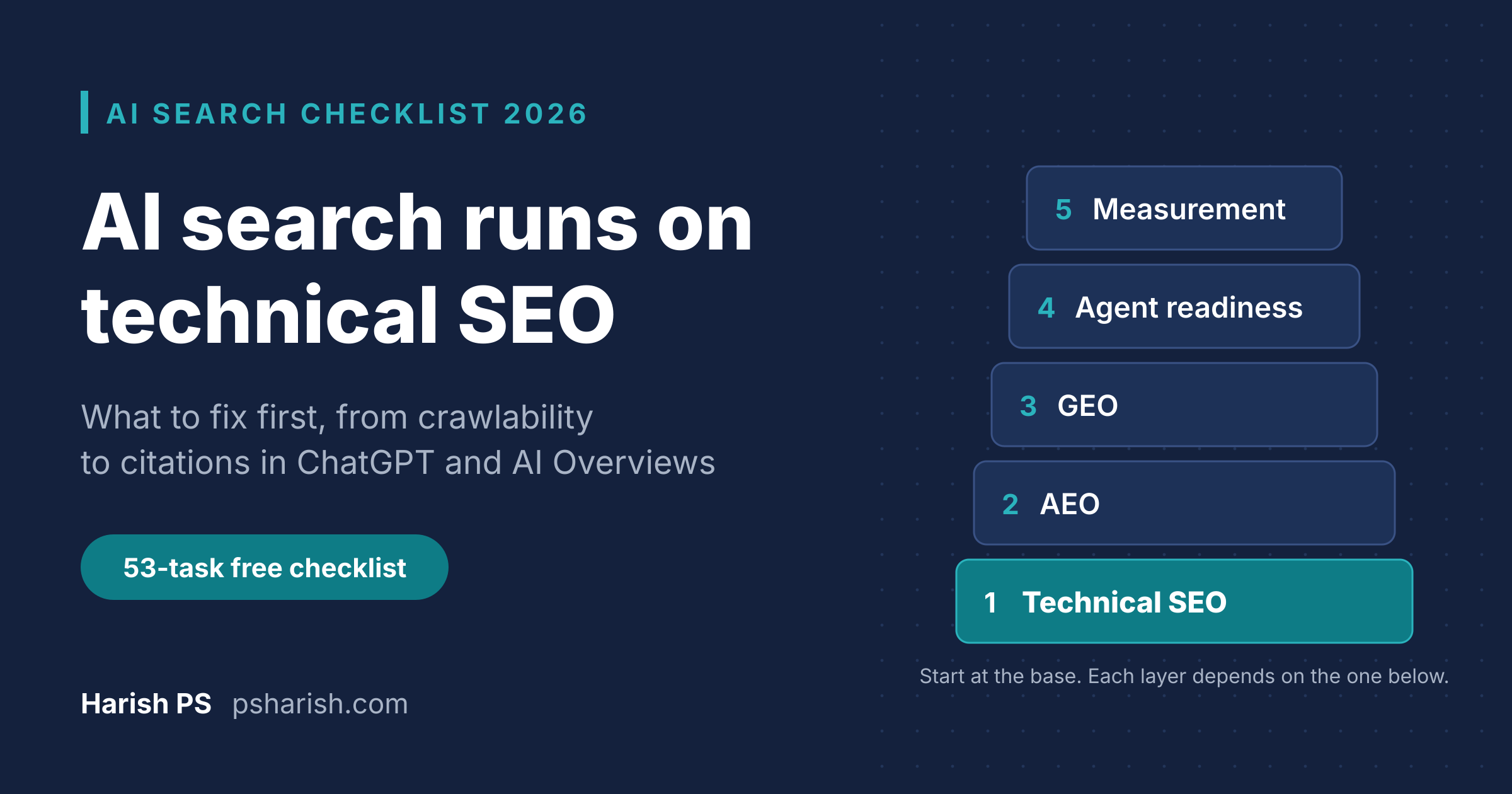
- Work in this order: technical SEO, then AEO, then GEO, then agent readiness, then measurement. Each layer depends on the one beneath it.
- What moves AI visibility: content in the initial HTML, indexation in Bing as well as Google, deliberate rules for AI bots, citable passages and mentions on trusted third-party sites.
- What’s overrated: llms.txt. Most of these files are never requested by AI crawlers.
- Free download: the full checklist as a sheet you can copy.
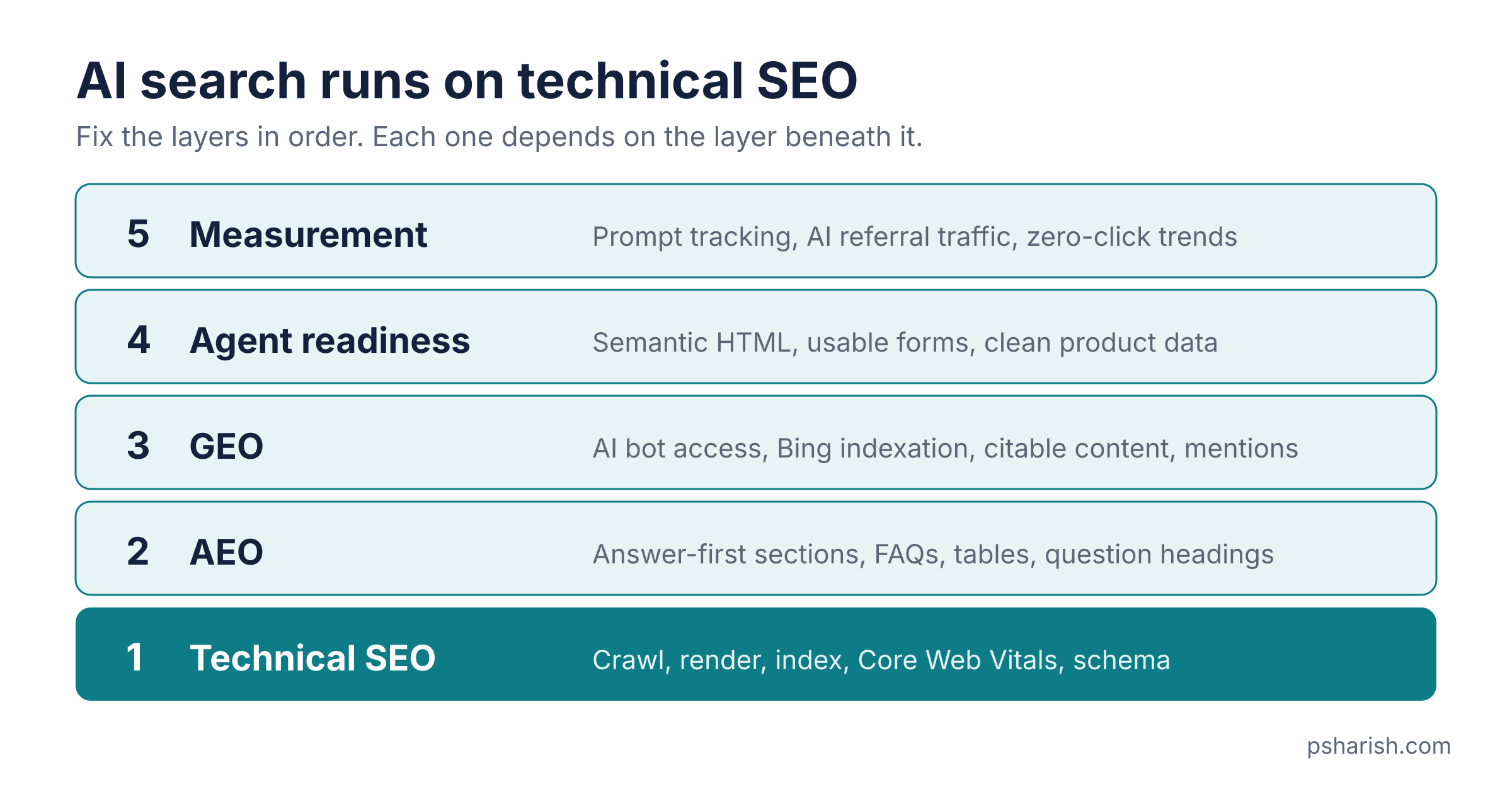
AI search didn’t replace SEO. It raised the cost of getting the basics wrong.
Every few weeks someone asks me which GEO tool they should buy. The question usually comes from a team whose key pages render in JavaScript, whose sitemap lists redirected URLs, and who have never opened Bing Webmaster Tools.
That order is backwards. An AI engine can only cite a page it can fetch, read and trust. Retrieval bots render JavaScript worse than Googlebot does, several assistants ground their answers on Bing’s index, and a page that is slow or inconsistent gives a model no reason to choose it over a competitor’s.
So this checklist starts where the engines start: can they reach you? Only then does it move to being the answer (AEO), being cited (GEO), and being usable by AI agents.
SEO, AEO, GEO and AI SEO: what each one means
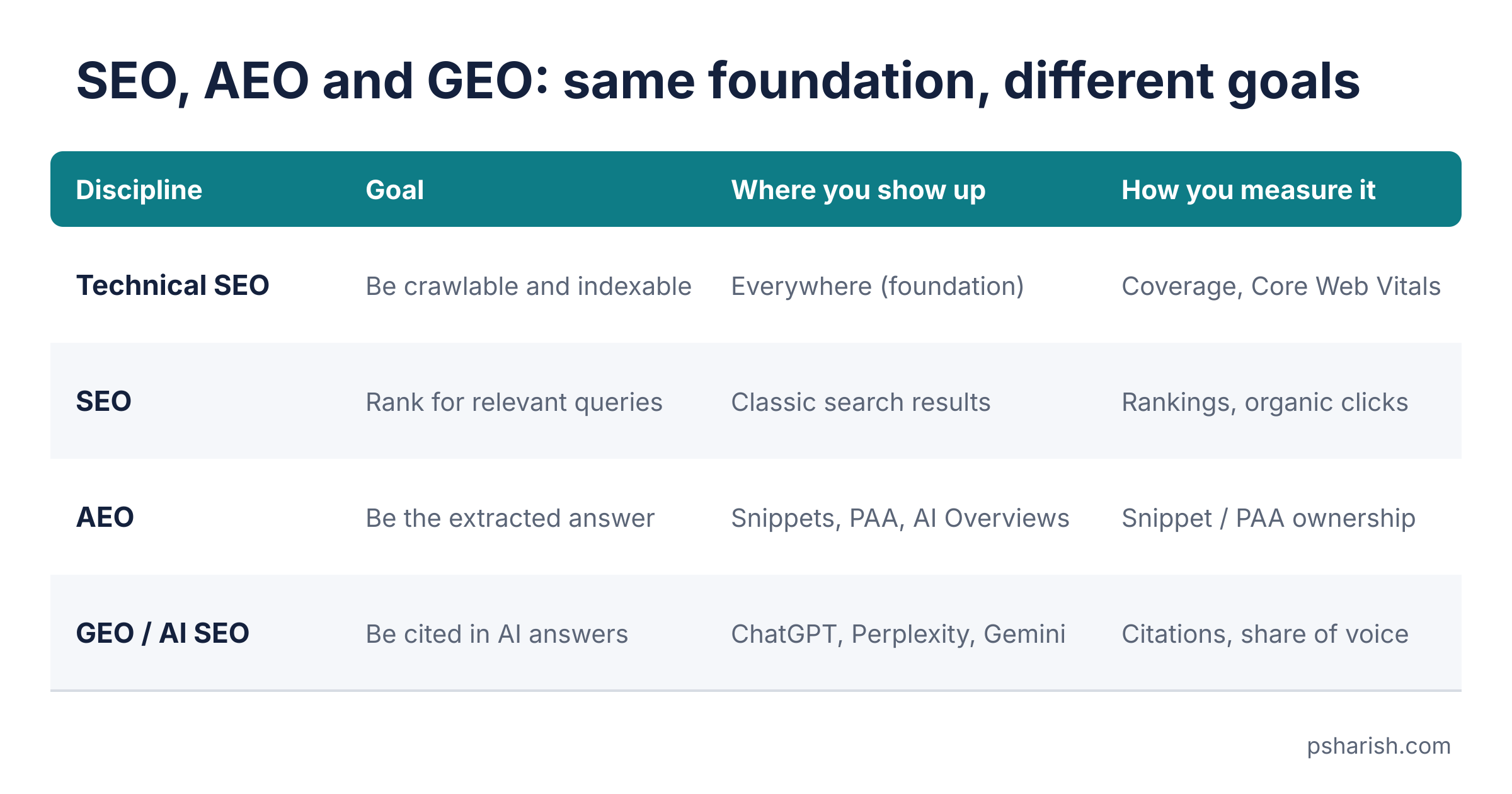
These terms overlap, but each one has a different goal.
| Discipline | Goal | Where you show up | How you measure it |
|---|---|---|---|
| Technical SEO | Search engines and AI bots can crawl, render and index the site | Everywhere, as the foundation | Index coverage, Core Web Vitals, crawl errors |
| SEO | Rank for relevant queries | Classic blue links | Rankings, organic clicks |
| AEO (Answer Engine Optimization) | Be the extracted answer | Featured snippets, People Also Ask, voice, AI Overviews | Snippet and PAA ownership |
| GEO / AI SEO / LLMO | Be cited or recommended inside generated answers | ChatGPT, Perplexity, Gemini, Copilot, Claude, AI Mode | Citations, mentions, share of voice, AI referral traffic |
GEO, AI SEO and LLMO (large language model optimization) are mostly different names for the same work. The vocabulary matters less than the order you do things in.
Layer 1: Technical SEO, the foundation
If a page can’t be crawled, rendered and indexed, nothing further up the stack matters.
Crawl and index
- Audit robots.txt for accidental blocks, and check noindex tags and X-Robots-Tag headers.
- Keep XML sitemaps clean: only canonical, indexable URLs that return 200, with accurate lastmod dates.
- Fix redirect chains, 4xx/5xx errors and orphan pages. Pages that return non-200 codes may be skipped for rendering entirely.
- Review Search Console and Bing Webmaster Tools coverage, especially “crawled, currently not indexed”.
- Turn on IndexNow so Bing and other engines that use it see new and updated pages quickly.
- Read your server logs to see what Googlebot, Bingbot and AI bots actually request.
Rendering
- Serve core content, links and structured data in the initial HTML using SSR, SSG or ISR.
- Don’t hide key content behind tabs, accordions or “load more” buttons that need a click.
- Check that CSP headers and blocked resources don’t break rendering.
Performance
- Meet the Core Web Vitals thresholds in field data: LCP under 2.5s, INP under 200ms, CLS under 0.1.
- Watch TTFB, and audit third-party scripts. They are usually the cause of poor INP.
- Keep mobile and desktop at parity: the same content, links and schema.
Architecture
- Keep important pages within three clicks of the homepage.
- Link internally with descriptive anchor text and build topic hubs.
- Use clean URLs and breadcrumbs, and control faceted and parameter URLs.
- For international sites, set hreflang with an x-default.
Structured data
- Use JSON-LD for Organization, WebSite, Person (author), Article, BreadcrumbList, and FAQ, Product or Service where they apply.
- Use sameAs links to connect your entity to LinkedIn, Wikidata and other authoritative profiles.
- Validate everything, and make sure the schema matches what’s visible on the page.
Layer 2: AEO, becoming the answer
AEO means formatting a page so an engine can lift a clean answer from it. The work is mostly editorial, but it can be done systematically.
- Map the questions people actually ask, using People Also Ask, support tickets, sales calls and site search.
- Put a direct answer of 40–60 words right under each question heading, then expand on it.
- Use the formats engines extract well: definitions, numbered steps, comparison tables and FAQ blocks.
- Write headings as the question a reader would type, not as clever labels.
- Cover conversational, long-tail phrasing for voice and assistant queries.
This post is formatted that way on purpose: a summary at the top, question-style headings, and an FAQ at the end.
Layer 3: GEO, getting cited by AI engines
GEO is about earning a place in generated answers. Part of it is technical, and much of it is about reputation.
Decide which AI bots can access the site
- Treat training crawlers (GPTBot, ClaudeBot, Google-Extended, CCBot) separately from retrieval and search bots (OAI-SearchBot, ChatGPT-User, PerplexityBot, Claude-SearchBot). Make a deliberate decision for each.
- Blocking has a cost. Research from Rutgers and Wharton published in April 2026 found news publishers that blocked AI crawlers lost roughly 7% of weekly traffic within six weeks (PPC Land).
- Check your CDN and WAF. Bot-protection defaults can block retrieval bots without anyone noticing.
Get indexed in Bing as well as Google
- Several AI assistants ground their answers partly on Bing’s index. Verify the site in Bing Webmaster Tools, submit sitemaps and use IndexNow.
Make content citable
- Write self-contained passages that still make sense when lifted out on their own.
- Add original data, named sources, specific numbers and a visible “last updated” date. Refresh key pages on a schedule.
- Show E-E-A-T signals: real author bios, credentials, first-hand experience and an editorial policy.
- Build topic clusters rather than isolated posts.
Strengthen your entity and off-site signals
- Describe your brand the same way on your site, LinkedIn, directories and Wikidata.
- Earn mentions in publications, communities, review sites and podcasts that AI engines trust. This is often the biggest lever, and it’s the one that technical work can’t replace.
The llms.txt reality check
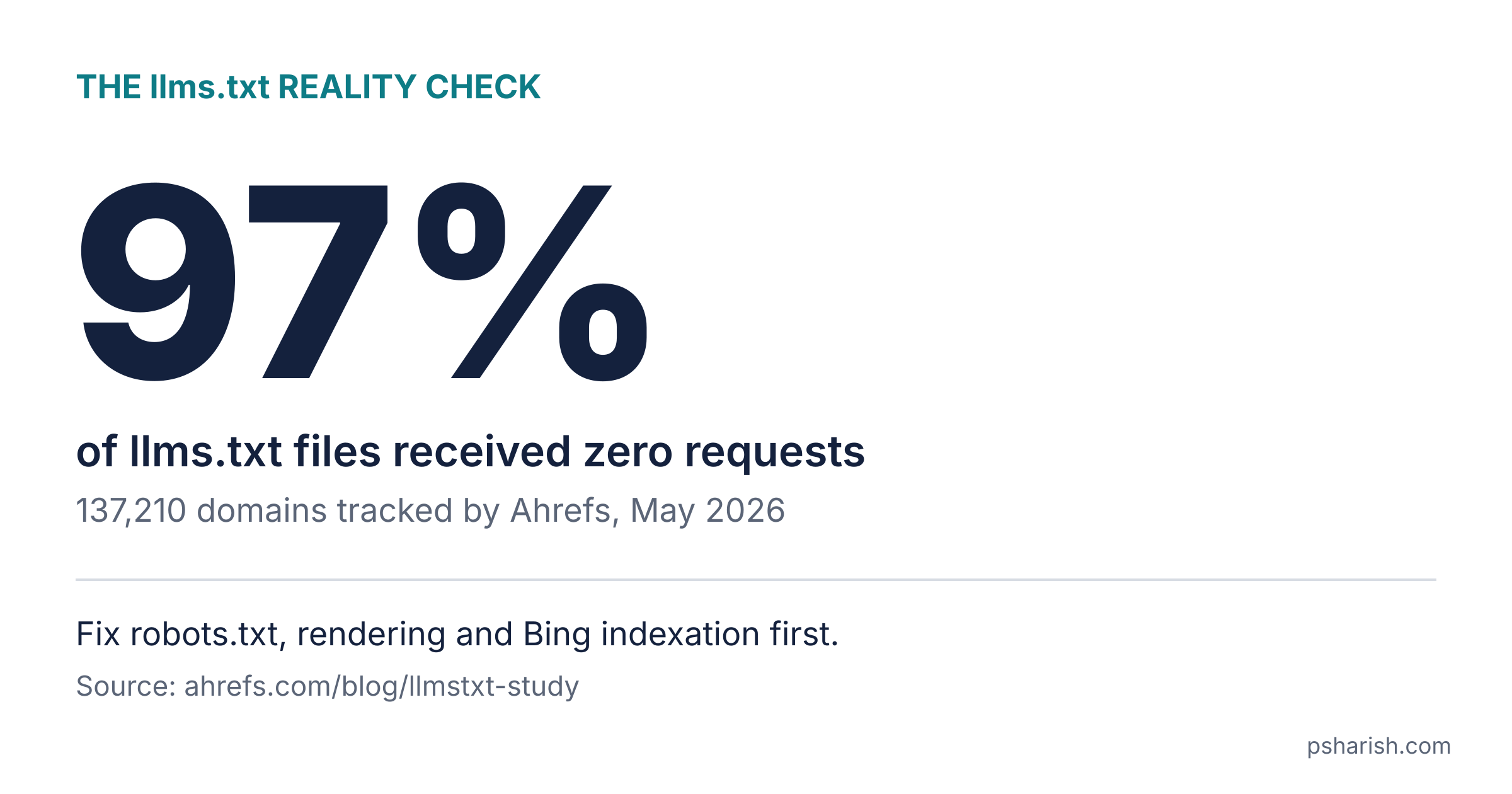
llms.txt is a proposed Markdown file that summarises a site for language models. Ahrefs tracked 137,210 domains and found 97% of llms.txt files received zero requests in May 2026 (Ahrefs). Google’s guidance says the file won’t help or hurt visibility in Search (Optimizely).
It costs little to add, and it can help developer tools. But don’t treat it as an AI-visibility strategy.
Layer 4: Agent readiness
AI agents are starting to act on websites as well as read them: comparing plans, filling in forms and starting checkouts. A site an agent can’t operate loses that conversion.
- Use semantic HTML, real buttons and labelled form fields. Good accessibility is also good agent readiness.
- Keep layouts stable, and put prices, plans and product details in plain HTML and schema rather than images.
- Keep product feeds accurate for AI shopping surfaces.
- Watch the emerging standards. Google added an “Agentic browsing audits” section to Lighthouse in May 2026, and WebMCP is moving into a Chrome origin trial (PPC Land).
Layer 5: Measuring AI visibility
Without a baseline, you can’t tell whether any of this work is paying off.
- Prompt tracking: choose 20–50 prompts your buyers would ask and run them on ChatGPT, Perplexity, Gemini, Google AI Overviews and AI Mode, Copilot and Claude. Record mentions, citations, which competitors appear, and sentiment.
- AI referral traffic: create a GA4 channel group for chatgpt.com, perplexity.ai, gemini.google.com, copilot.microsoft.com and claude.ai.
- Zero-click erosion: compare impressions against clicks in Search Console. Rising impressions with flat clicks often means AI answers are absorbing the click.
- Cadence: check prompts weekly, review citation trends and refresh content monthly, and run a full technical audit each quarter.
Where to start: your first 30 days
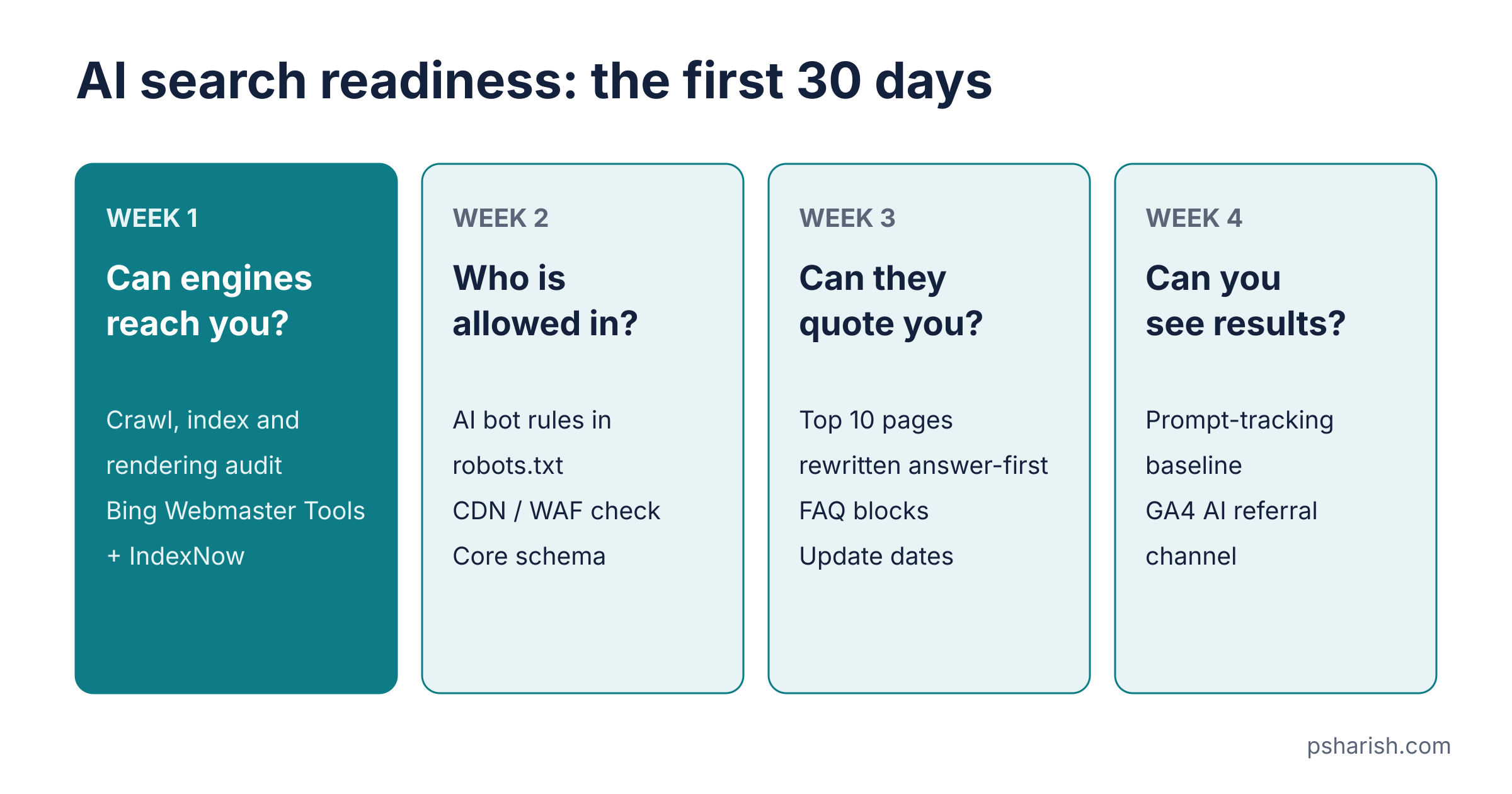
If you can only do one thing a week, do these four in order.
- Week 1: Can engines reach you? Run a crawl, index and rendering audit. Verify the site in Bing Webmaster Tools and turn on IndexNow.
- Week 2: Who is allowed in? Set explicit robots.txt rules for AI bots, check CDN and WAF bot settings, and ship Organization, Person and Article schema.
- Week 3: Can they quote you? Rewrite your ten highest-value pages in answer-first format with FAQ blocks and update dates.
- Week 4: Can you see results? Set up the prompt-tracking baseline and the GA4 AI referral channel.
After that, the work becomes ongoing: earn mentions on other sites, refresh content, and audit every quarter.
FAQ
GEO is about being cited inside AI-generated answers; SEO is about ranking in search results. They share the same foundation of crawlable, indexable, trustworthy content, so GEO extends SEO rather than replacing it.
It depends on your content model. Blocking training crawlers keeps your content out of model training. Blocking retrieval bots such as OAI-SearchBot or PerplexityBot removes you from live AI answers. Most businesses that want leads should allow the retrieval bots.
No. Studies show AI crawlers rarely request it, and Google says it has no effect on Search. Adding one does no harm, but it shouldn’t come before robots.txt, rendering or Bing indexation.
ChatGPT search has historically drawn on Bing among other sources, and providers change their sources over time. The practical answer is to get indexed and healthy in both.
Track a fixed set of prompts across the major assistants every week, and segment AI referral traffic in GA4. Paid AI-visibility tools can automate the prompt tracking.
Get the checklist
Download the full checklist as a sheet you can copy: make your own copy. If you’d like a quick AI-search readiness review of your site, get in touch.