MarTech stack development that sends sales only the leads worth calling

Connect, validate, enrich and score every lead, then route it to sales with the context they need. Built on the stack you already own, with each new tool added only when a real use case justifies it.

Sound familiar?

Most B2B marketing teams don't have a tool problem. They have a connection problem.

Tap the ones that apply to you.

What MarTech stack development covers

I design, build and connect your stack across five workstreams that run in parallel, so dependencies land together instead of being reworked later. Then I hand it over so your team owns it.

Orchestration & Enrichment

Orchestration & Enrichment

ICP fit, firmographics, intent signals and routing rules. Every tool goes through a use-case workshop before you buy it.

Data & CRM

Data & CRM

Cleanse the existing database, put a validation gate on every entry point and set clear lead stages up to the sales handoff.

Automation

Automation

Finish the migration that stalled, rebuild the critical workflows and get one scoring model live that the whole team agrees on.

Engagement

Engagement

Nurture by segment and stage, LinkedIn outreach through approved routes only, and real-time alerts when an account heats up.

Insight

Insight

A leadership dashboard built module by module as each data source comes online, with closed-loop reporting once outcomes flow back.

Governance & Handover

Governance & Handover

Documentation, field ownership and training, so your team runs the stack without depending on me.

How the work runs

Every feature follows the same path, from requirements to handover. Nothing goes live without sign-off, testing and training.

  1. 01

    Requirements

    A short PRD for each feature: what it must do, for whom, and how we’ll know it works.

  2. 02

    Design sign-off

    Field maps, flows and rules approved by your team before anything is built.

  3. 03

    Build

    Hands-on configuration and integration in your stack, not slideware.

  4. 04

    Testing

    My own testing, plus vendor QA wherever a third-party tool is involved.

  5. 05

    UAT

    Your team tests against real scenarios and signs off.

  6. 06

    Go-live & training

    Released, documented and shown to the people who’ll use it.

  7. 07

    Operate

    I run it alongside your team, tune scoring and fix what real usage exposes.

  8. 08

    Transfer

    Full documentation and a clean handover, so your team owns the stack.

Principles I don't compromise on

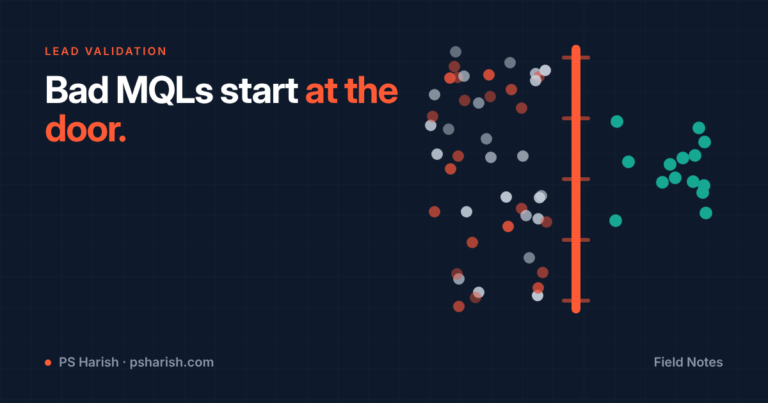
  • Validate at the door. Bad data is cheaper to stop than to clean.
  • One profile, owned by you. A customer data platform such as Data 360 (formerly Data Cloud) holds the single view of each lead and account, so your engagement data lives in your system, not scattered across vendors.
  • Workshop before you buy. Every tool purchase starts with a use case, and vendor claims are tested against it. You buy and own every licence.
  • No shortcuts on platform rules. No LinkedIn automation that puts your reps' accounts at risk.

Start on day one. Touch data only when it’s cleared.

Work starts the day we sign. Your customer data stays where it is until it’s cleared, because an NDA is not data clearance.

Day one: start the work

Audit, architecture, workflow specs, content and vendor groundwork. No customer data needed.

The gate: get it cleared

InfoSec review, privacy sign-off on the purpose, and data-processing terms with every recipient.

After clearance: use the data

Export, cleanse, enrich and upload records, and share them with vendors.

Throughout: consent & retention

Checked against DPDP, GDPR, CAN-SPAM and CASL. Your legal team makes the final call.

How we work together

A monthly retainer with fortnightly reviews, so priorities can shift without renegotiating the contract.

You see progress every two weeks and decide what comes next. Delivery dates depend on access, approvals and vendor availability, so blockers are raised early rather than discovered late.

  • Monthly retainer: work is prioritised jointly at each sprint review, within an agreed capacity.
  • Fortnightly sprint reviews: what shipped, what’s next, and what’s blocked.
  • One-page sprint summary that leadership can present as is.
  • A live RAID log (risks, assumptions, issues, dependencies), so problems surface before they cause delays.
  • On-site and remote, as the work needs.

Results from past work

17+ years connecting siloed marketing stacks, as an architect who also builds.

Across cybersecurity, FinTech, manufacturing and SaaS teams, including reporting automation that turned a quarterly report taking a full sprint into an automated one.

70 % faster campaign launches · global cybersecurity group
70 %

faster campaign launches · global cybersecurity group

30 % shorter sales cycle · same programme, Salesforce + Marketo + 6sense
30 %

shorter sales cycle · same programme, Salesforce + Marketo + 6sense

25 % higher customer engagement · FinTech CDP pipeline
25 %

higher customer engagement · FinTech CDP pipeline

70 K+ unknown contacts resolved · global industrial manufacturer
70 K+

unknown contacts resolved · global industrial manufacturer

Who this is for

Not the right fit if you need a tool reseller, paid media management or a website build.

This works best for B2B teams whose marketing stack has grown faster than it was designed, where the tools exist but the lead flow between them doesn’t.

  • You run B2B marketing on Salesforce or HubSpot with a marketing automation platform.
  • You have long sales cycles and buying committees, not single buyers.
  • You hand leads to a separate sales team or CRM.
  • Leadership is asking for pipeline visibility you can’t produce today.
  • You want your team to own the stack after handover, not depend on a consultant.

FAQs

It depends on scope and how quickly access and approvals land. Most engagements get the core lead flow live within the first few months, with the full build typically taking one to two quarters. The plan is reviewed at every fortnightly sprint.

Not necessarily. We start with what you already own. If a gap needs a new tool, such as enrichment or orchestration, we run a use-case workshop first and you decide. You buy and own every licence.

Yes. I usually work with in-house admins, implementation partners and agencies. I own the architecture and the end-to-end flow; they keep what they already do well.

Nothing happens to it until it’s cleared. Design and build start on day one, but no records are exported, cleansed, enriched or shared until your InfoSec, privacy and data-processing approvals are in place.

Not with tools that break LinkedIn’s User Agreement, which prohibits bots and unauthorised automation for messaging and contacts. We use approved routes: Sales Navigator, its CRM sync where your licence includes it, and Salesforce tasks with AI-drafted messages that reps review and send.

I define the handoff spec (fields, stage rules and timing) and build the send from the marketing side. Your CRM team provides the receiving endpoint and the return feed. Closed-loop reporting depends on that return feed.

After the build, I run the stack alongside your team for a few months, tuning it on real data. Then I hand it over with documentation and training, so you’re not dependent on me.

Find out where your leads are leaking

Tell me where your leads get stuck

Share a few lines about your stack and your biggest lead-flow problem. I’ll reply within two working days, either with times for a 45-minute stack audit call or a straight answer if a full build isn’t what you need.

Call Us On

+91 89040 33369

Email Us At

harish@psharish.com

Visit Office

Bengaluru, Karnataka, India

    Field notes on MarTech

    Practical notes from real stack work: lead flow, data quality, automation and what actually breaks.

    Blog, CRM, MarTech

    18 October 2026 By PS Harish

    At a glance When sales says “these MQLs are rubbish”, marketing teams usually reach for the scoring model. They add points here, take points away there, and raise the threshold. Three months later, sales says the same thing. That’s because scoring can’t fix a lead that should never have been in the system. If a […]

    Read More…

    Digital Strategy, E-Commerce

    17 October 2026 By PS Harish

    15 tool categories to build the business behind your storefront Launching an online store feels like the hard part. The catalog is ready, checkout works and the first orders begin to arrive. Then the work spreads. A customer asks where their package is. A supplier needs a purchase order. Stock on the website disagrees with […]

    Read More…

    Blog, Product Management, UX

    3 September 2026 By PS Harish

    The last post was about the wall — how a handful of individually reasonable onboarding requirements stack into something that quietly costs a product its users, before they’ve done anything with it. This one is the fix. Not “remove the checks,” because fraud and spam are real problems. The fix is rebuilding onboarding as three […]

    Read More…

    © 2026 PS Harish