At a glance
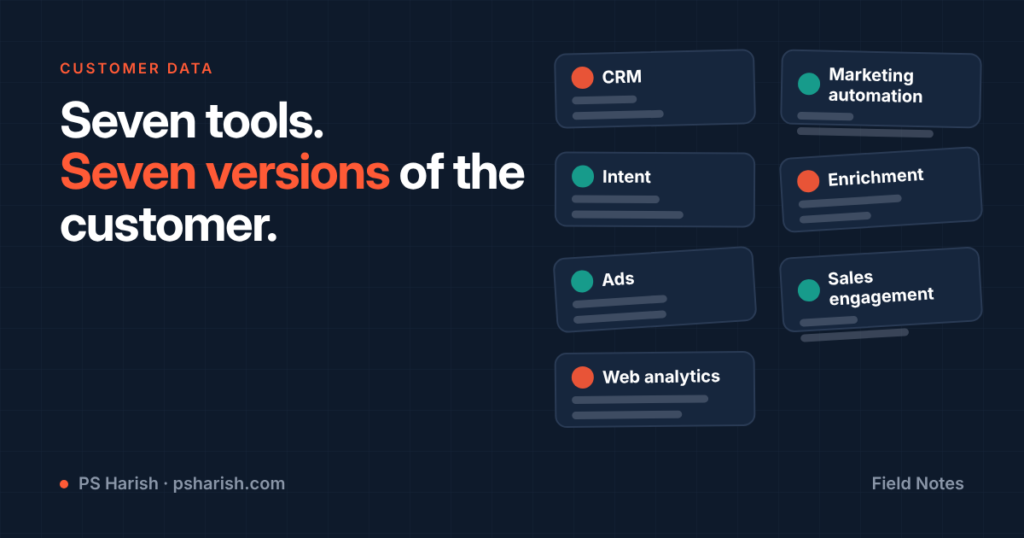
- In most B2B stacks, every tool holds its own slice of the buyer, so scores, segments and reports disagree.
- A customer data platform (CDP) gives you one profile per lead and account that every tool reads from and writes back to.
- That profile sits in your system, so your engagement history doesn’t depend on any one vendor.
- Watch the practical details: consumption costs, batch versus real time, identity-resolution scope and vendor data terms.
- The dashboard comes last. Build it on a profile you trust, not on seven that disagree.
Here’s a scene from most B2B marketing reviews.
The marketing automation platform says an account is hot. The intent tool says it’s cooling off. The CRM shows no activity in 60 days. The sales rep says they spoke to them yesterday. Four systems, four answers, and the meeting turns into an argument about whose number is right.
None of the tools is broken. Each one is doing exactly what it was set up to do, with the slice of data it can see.
Why the slices don’t add up
Every tool you add creates its own record of the customer:
- Marketing automation knows email opens, form fills and page visits.
- The CRM knows meetings, opportunities and deals.
- Intent and ABM tools know research activity on other sites.
- Enrichment tools know firmographics and contact details.
- Ad platforms know impressions and clicks.
- Sales engagement tools know calls and sequences.
- Web analytics knows sessions, but mostly anonymously.
Each tool also has its own matching logic, its own idea of what an “account” is, and its own scoring. So the same person can be three records in one system and missing from another.
When teams try to fix this with point-to-point syncs, they get a web of integrations where every connection is a new place for data to break or overwrite something else.
One profile, many tools
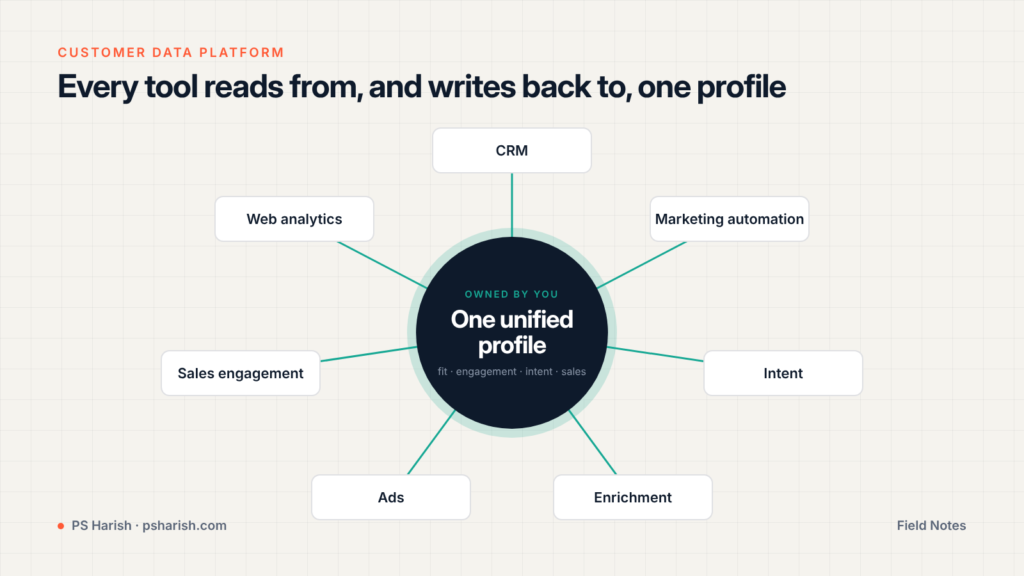
A CDP changes the shape of the stack. Instead of tools syncing with each other, they all connect to one central profile:
- Data comes in from every source: engagement, intent, enrichment, CRM activity and web behaviour.
- Identity resolution matches records that belong to the same person or account.
- One unified profile holds the combined view, including fit and engagement.
- Segments and scores are calculated once, on that profile.
- Every tool receives the same answer, whether that’s a segment, a score or a trigger.
In a Salesforce stack, this is the job of Data 360 (formerly Data Cloud). In other stacks it might be a different CDP, or a warehouse-first setup with tools like Databricks. The pattern matters more than the product.
Own your data, not your vendors
There’s a second reason to centralise, and it gets less attention: ownership.
If your engagement history only lives inside vendor tools, it’s only as durable as those contracts. Switch your intent provider and years of signals may go with it. Replace your enrichment tool and the enriched fields may become unusable under the old vendor’s licence terms.
When the unified profile sits in your own platform:
- You can replace a tool without losing the history it helped build.
- You decide retention and consent in one place, which makes privacy requests (access, correction, erasure) far easier to handle.
- Your scoring model belongs to you, not to a vendor’s black box.
Before you load any third-party data into the profile, check the vendor’s licence and retention terms. Some data can be used but not stored past the contract, and some can’t be shared with other tools.
What goes into the profile
For B2B lead-to-revenue work, four kinds of data matter most:
| Type | Examples | Answers the question |
|---|---|---|
| Fit | Industry, size, region, role, tech stack | Should we sell to them at all? |
| Engagement | Emails, forms, webinars, site visits, events | Are they interacting with us? |
| Intent | Research topics, competitor comparisons, surges | Are they in market right now? |
| Sales activity | Meetings, calls, opportunities, outcomes | What happened when we engaged? |
Score on all four and the arguments in review meetings get much shorter, because everyone is looking at the same profile.
The watch-outs
A CDP isn’t a magic box. These are the things that catch teams out:
- Consumption costs. Many CDPs, Data 360 included, charge by usage. Unscoped ingestion and frequent recalculation can run up a large bill. Agree what gets ingested, and how often, before go-live.
- Batch versus real time. Not every use case needs real time. Alerts for hot accounts might; a weekly segment refresh doesn’t. Real time costs more.
- Identity-resolution scope. Matching rules that are too loose merge different people; rules that are too strict leave duplicates. Start narrow, test on real data, then widen.
- Garbage in, unified garbage out. A CDP amplifies whatever you feed it. Put a validation gate in front of it first.
- Approvals. Moving customer data into a new platform needs InfoSec and privacy sign-off, like any other data movement.
The dashboard comes last
Leadership usually asks for the dashboard first. It’s the visible part, and it’s what they’ll use.
But a dashboard built on seven conflicting sources just shows the mess faster. The order that works:
- Validate data at entry.
- Unify it into one profile.
- Agree on one scoring model.
- Then build the dashboard, module by module, as each source comes online.
Each module you add is then a number people believe, which is the whole point.
FAQa
A CRM is built around sales records and opportunities. It usually doesn’t hold anonymous web behaviour, intent data or high-volume engagement well. A CDP unifies all of that and feeds the CRM the parts sales needs.
Yes. Salesforce renamed Data Cloud to Data 360 in October 2025. You’ll still see both names in documentation and job posts.
Yes. Start with clean CRM data, one agreed scoring model and a validation gate. Add a CDP when the number of sources, or the cost of disagreements between them, justifies it.
Marketing operations usually owns it day to day, with clear agreements with sales operations and IT on fields, matching rules and access.
Want one profile your whole team trusts? Unifying the stack is part of my MarTech Stack Development service. Start with how to stop junk leads at the door.
By PS Harish
18 October 2026Comments
No comments yet.

Leave A Comment