Website & DX Audit
Best for Teams who suspect the site is the bottleneck
You get- Core Web Vitals and performance review
- SEO/AEO and schema gaps
- component and template inventory
- CMS governance review · prioritised fix list
Duration: 3 – 4 weeks

Platform-agnostic builds on AEM, Sitecore, Drupal, WordPress and headless. Modular, search-ready, and built so your marketing team can run it without a developer queue.
Tap the ones that sound familiar. Three or more, and the platform is the bottleneck, not your team.
Tap the ones that apply to you.
I don’t sell a platform. I help you choose the one that fits your team, content and roadmap, then build it the same disciplined way every time.
Whether you run AEM, Sitecore, Drupal, WordPress or a headless stack, the same engineering principles apply. Because I’m not tied to a vendor, my advice is unbiased, the architecture outlasts any single platform decision, and your next migration doesn’t start from zero.
Eight standards that stay the same, whatever the platform.

Your team builds new pages from approved, tested modules. No developer needed for each one.

Native blocks and structured fields. No page-builder bloat and no lock-in.

Semantic HTML, schema, FAQ markup and answer-ready structure, so you’re found in Google and in AI search.

Translatable templates and field-level content, ready for WPML, Polylang or your platform’s localisation tools when you add markets.

Colour, type and spacing live in design tokens. A new look is a CSS change, not a rebuild.

Accessible, mobile-first layouts, tested on real devices and built around how your buyers decide.

Fast landing pages for PPC, clean GA4 and GTM tracking, Open Graph cards on every page, and consent handled properly.

CRM, marketing automation, DAM, PIM, search and analytics wired in from day one.
Both get a site live. Only one stays fast and manageable at enterprise scale.
| Aspect | Typical page-builder site | How I build |
|---|---|---|
| Markup | Deeply nested wrappers, extra CSS and JS on every page | Lean semantic HTML, only the code each module needs |
| Content | Stored in the builder’s own format | Structured fields that move to any CMS or headless front end |
| Rebrand | Restyle page by page | Change the design tokens once |
| Governance | Editors can change any style, so the brand drifts | Editors fill approved fields, so the brand stays consistent |
| Multilingual | Layouts duplicated and rebuilt per language | Fields translated, layouts shared |
| Search | Schema added by plugins, often inconsistent | Schema and FAQ markup built into components |
| Performance | Core Web Vitals regress with every release | Performance budget set at component level |
Enterprise DXPs, open-source CMS and headless stacks. Same principles, chosen to fit.

Component and template architecture, multi-site and multilingual rollouts, connected to Adobe Analytics and Target.

Component-based builds, content governance and personalisation-ready templates.

Enterprise Drupal, including Acquia: structured content types, multisite and multilingual.

Custom block themes with structured fields and no page builders. This site is built that way.

Contentful and Strapi with React and Next.js front ends, on API-first content models.

Shopify, WooCommerce, Magento and BigCommerce, from store build to growth.
Most clients start with one focused piece of work, then build from there.
Best for Teams who suspect the site is the bottleneck
You getDuration: 3 – 4 weeks
Best for Teams deciding whether to stay, upgrade or go headless
You getDuration: 8 12 weeks
Best for Sites that work but are hard to manage
You getDuration: 13 – 20 weeks
Best for New sites, rebrands and platform moves
You getDuration: 40+ weeks
A clear path from first call to a site your team can run.
Goals, audiences, content, current stack and what’s blocking growth.
Platform choice, content model, component map and integrations.
Tokens, modules and UX patterns, approved before build starts.
Modular components with SEO/AEO and tracking built in.
CRM, automation, analytics, DAM, PIM and search connected.
Desktop, mobile, speed, schema, tracking and redirects checked.
Documentation, editor training and a roadmap for what comes next.
Both. Most of my clients are Series B-and-later startups and enterprise teams whose website has to scale across markets, brands or product lines.
It depends on your team, content, integrations and budget. I’m platform-agnostic, so the recommendation is based on fit, not partnerships. The Replatforming & Headless Assessment gives you that answer in writing.
Yes. Often the best first step is a component system or a clean-up on the platform you already have.
Fast, semantic pages; structured data, including Service and FAQ schema; clean internal linking; and content structured so search engines and AI assistants can quote it accurately.
Template text is translatable, content lives in structured fields, and URLs support language prefixes and hreflang. Adding a language becomes translation and configuration, not a rebuild.
They make pages heavier, store content in their own format, and let editors change styling freely. At enterprise scale that costs you speed, portability and brand consistency.
Yes. Editors build pages from approved modules and fill in fields. Developers are needed for new modules, not new pages.
Yes: Shopify, WooCommerce, Magento and BigCommerce. See my E-commerce services page.
NDAs are standard, and I never publish a client’s name or work without their approval.
Yes. I’m based in Bengaluru and work with teams globally, across time zones.
How I think about websites, search and growth.
19 October 2026 By PS Harish
At a glance The pitch for LinkedIn automation tools is simple: connect them to your reps’ accounts, upload a list, and let the tool send connection requests and follow-ups while everyone sleeps. It’s tempting, especially when leadership wants more pipeline and LinkedIn is where your buyers are. But there’s a problem most demos skip. What […]
18 October 2026 By PS Harish
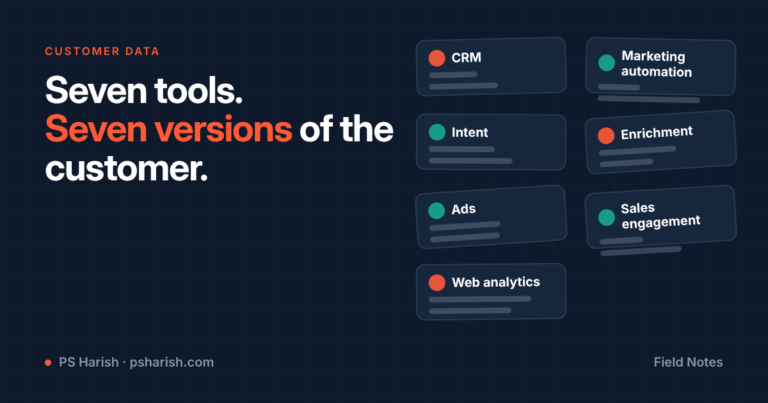
At a glance Here’s a scene from most B2B marketing reviews. The marketing automation platform says an account is hot. The intent tool says it’s cooling off. The CRM shows no activity in 60 days. The sales rep says they spoke to them yesterday. Four systems, four answers, and the meeting turns into an argument […]
18 October 2026 By PS Harish
At a glance When sales says “these MQLs are rubbish”, marketing teams usually reach for the scoring model. They add points here, take points away there, and raise the threshold. Three months later, sales says the same thing. That’s because scoring can’t fix a lead that should never have been in the system. If a […]
A short call to walk through your platform, what’s slowing your team down and where to start.
Call Us On
+91 89040 33369
Email Us At
harish@psharish.com
Visit Office
Bengaluru, Karnataka, India
© 2026 PS Harish