Every e-commerce growth conversation eventually lands on the same three levers:
- Get more traffic
- Improve conversion rate
- Increase average order value
In practice, 80% of the effort goes to the first one. Most of what’s left goes to the second. The third — Average Order Value (AOV) — is almost always the most neglected, despite often being the fastest to move.
Here’s why that’s a costly mistake, and how to fix it.
Key Takeaways
- E-commerce growth comes down to three levers: traffic, conversion rate, and average order value (AOV). Most of the effort goes to traffic. AOV is the most neglected, even though it is often the fastest to move.
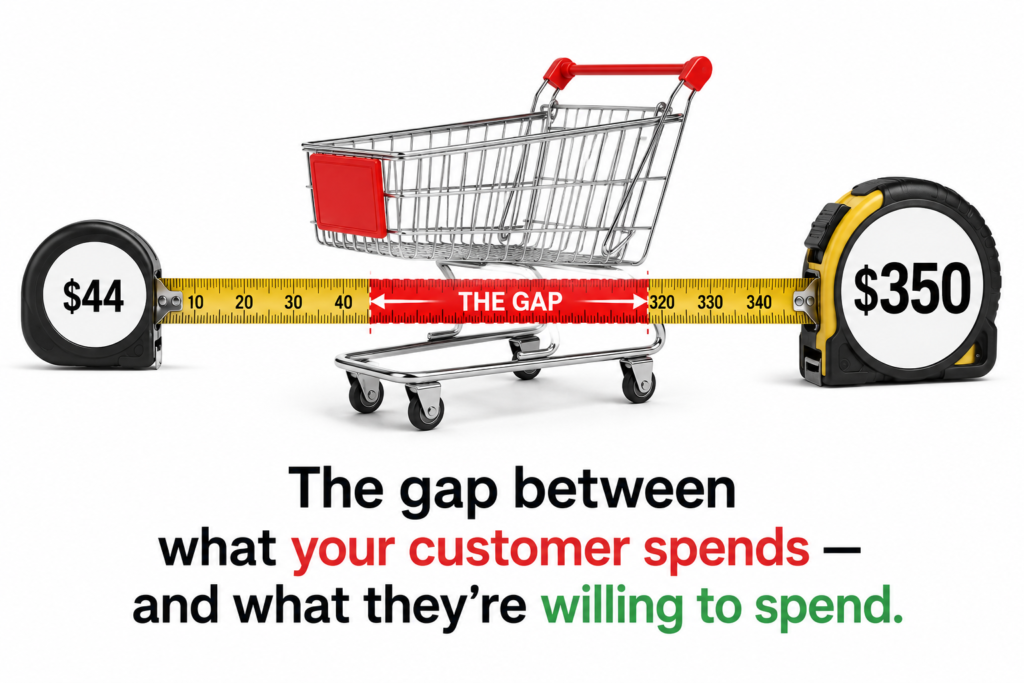
- In a recent audit, a pet brand captured $44 per order, while US pet owners spend $250–$350 a month on their pets. The gap came from strategy, not the product or pricing.
- At the same 10,000 monthly visitors and 1.56% conversion rate, raising AOV from $44 to $75 lifts monthly revenue from $6,864 to $11,700. That is about 70% more revenue with zero extra acquisition spend.
- The three levers to fix first are product- and cart-level bundles, a subscription with a value hook stronger than “subscribe and save 10%”, and a three-email post-purchase sequence in the 72 hours after the first order.
- AOV drives customer lifetime value. At a 30% margin, $44 × 2 orders a year is about $26 in contribution, while $75 × 6 subscriber orders is $135. The first is too thin to fund paid acquisition. The second can invest in growth.
The $44 Problem
In a recent e-commerce audit, the brand’s average order value was $44.
US pet owners spend, on average, $250–$350 per month on their pets — food, treats, toys, supplements, accessories, vet supplies. Some households spend significantly more.
This brand was capturing $44 per order.
Not $44 per month from each customer. $44 per transaction, with infrequent repeat purchases and no subscription offering.
The gap between what their customers were willing to spend and what the brand was capturing wasn’t a product problem. They had a broad catalogue. It wasn’t a pricing problem. Their prices were competitive.
It was a strategy problem. Specifically, the absence of three things:
- A subscription or continuity model
- Bundle logic at the product and cart level
- A post-purchase sequence designed to drive the second order
When these three elements are missing, you’re capturing the transaction without capturing the customer. You win once and start over.
Why AOV Is Often the Fastest Revenue Lever
Most growth channels have a lag before you see results:
- SEO improvements take 3–6 months to manifest in rankings and traffic
- Paid search takes time to optimise toward profitability
- Content marketing compounds over quarters, not weeks
AOV improvements can show results in days.
You don’t need new traffic. You don’t need to improve your rankings. You need the customers already in your funnel to spend more per visit — and you need to bring them back sooner.
The math is simple:
| Metric | Before | After AOV Fix |
|---|---|---|
| Monthly visitors | 10,000 | 10,000 |
| Conversion rate | 1.56% | 1.56% |
| Orders | 156 | 156 |
| AOV | $44 | $75 |
| Monthly Revenue | $6,864 | $11,700 |
Same traffic. Same conversion rate. 70% more revenue.
That’s the leverage of AOV — and it requires zero additional acquisition spend.
The Three Levers I Address First
1. Bundle Offers at the Product and Cart Level
Bundles serve two purposes: they increase AOV and they simplify the buying decision.
A customer who arrives to buy dog food shouldn’t have to think about whether to add treats and a supplement. A well-designed bundle does that thinking for them.
Product-level bundles: Present a curated starter kit or “frequently bought together” set on every product page. The discount doesn’t need to be large — 10–15% is sufficient to shift purchasing behaviour.
Cart-level bundles: When a customer adds one item to cart, surface a “complete the set” recommendation that brings AOV toward a meaningful threshold (e.g., “Add $16 to get free shipping and a free treat pack”).
The framing matters. “You might also like” is weak. “Complete your pet’s daily routine” is a customer-centric value proposition.
2. Subscription with a Compelling Value Hook
For consumable products — pet food, supplements, treats, grooming supplies — a subscription model is not optional if you want to build a real business. It’s foundational.
Subscription increases AOV in two ways:
- It converts a single purchase into a committed monthly revenue stream
- Subscribers typically order in larger quantities (3-month supplies, etc.)
The critical element is the value hook. “Subscribe and save 10%” is baseline — it’s what everyone offers. Stronger hooks:
- “Never run out — pause or cancel anytime”
- “Subscriber-only pricing on new products”
- “Free shipping on every order, always”
- “Personalised auto-delivery based on your pet’s consumption rate”
The last one is the most powerful — it signals you understand the customer’s need better than they track it themselves. That’s a loyalty driver, not just a discount.
3. Post-Purchase Email Sequence (72-Hour Window)
The highest-intent moment in a customer relationship is immediately after they purchase. They’ve committed to your brand, their card is on file, and their pet is about to experience your product.
Most brands send a receipt and disappear. Sometimes it isn’t even a choice: the data that should trigger those emails never reaches the email platform, a pattern I broke down in You’re Growing. But Are You Growing on a Broken Foundation?
A well-built post-purchase sequence in the 72 hours after purchase can drive 15–25% of customers to a second order within 30 days. Here’s a simple three-email structure:
Email 1 (Immediately): Order confirmation + “Your pet is going to love this” — set expectations and reinforce the purchase decision.
Email 2 (24–48 hours): Product education content — how to introduce the food/supplement, what to expect, care tips. Build trust and reduce buyer’s remorse.
Email 3 (72 hours): Soft cross-sell — “Customers who bought X also love Y.” One product, specific to what they bought, with a 15% first-add discount. No aggressive sell. Just a natural next step.
This sequence costs almost nothing to set up in any modern email platform. The ROI is almost always immediate. And if the flow is built but never fires, work through the 7 root causes of marketing automation that isn’t working.
AOV and Customer Lifetime Value
AOV doesn’t exist in isolation. It’s directly connected to Customer Lifetime Value (CLV) — the metric that determines how much you can afford to spend acquiring each customer.
If your AOV is $44 and a customer orders twice per year, their annual value is $88. At a 30% margin, you’re working with $26 in contribution per customer per year. You can’t build a meaningful paid acquisition program on that.
If your AOV is $75 and a subscriber orders 6 times per year, their annual value is $450. The same 30% margin gives you $135 in contribution. Now you have a business that can invest in growth.
This is why AOV isn’t just an e-commerce metric. It’s a business model metric. A brand with low AOV and no subscription has a fundamentally different growth ceiling than one that’s solved both.
At a Glance: Capturing the Transaction vs. Capturing the Customer
| Capturing the transaction | Capturing the customer | |
|---|---|---|
| Average order value | $44 | $75 |
| Orders per customer per year | 2 | 6 (subscriber) |
| Annual value per customer | $88 | $450 |
| Contribution at 30% margin | ~$26 | $135 |
| Bundles | “You might also like” | Curated starter kits plus “complete your pet’s daily routine” cart offers |
| Subscription | None | Subscription with a value hook (e.g., personalised auto-delivery) |
| After the first purchase | A receipt | Three emails in the first 72 hours |
Start Here: The AOV Audit
Before building anything, run these three checks:
1. Calculate your current AOV by product category Not overall AOV — category AOV. You may find that certain product lines are dragging the average down while others are healthy. Fix the worst categories first.
2. Map your current post-purchase communication What does a customer receive after their first purchase? Day 1, Day 3, Day 7, Day 30? If the answer is “just a receipt,” you’ve found your fastest win.
3. Check your bundle and cross-sell implementation Go through your purchase flow as a customer. How many opportunities exist to add a relevant product before checkout? How many does the current experience actually present?
Most of what you find will be fixable in 30 days without engineering changes.
The Bigger Picture
When I look at a brand generating $30K/month with a $44 AOV and no subscription model, I don’t see a traffic problem. I see a revenue capture problem.
The customers are there. The intent is there. The spend capacity is absolutely there — a US pet owner spending $250–$350/month just isn’t spending it with you.
Fix AOV first. Then scale traffic. Otherwise you’re spending more to acquire customers into a leaky bucket.
Frequently Asked Questions
Average order value (AOV) is what a customer spends per transaction. In the example in this post, 156 orders at $44 each produce $6,864 in monthly revenue. Brands neglect it because about 80% of growth effort goes to getting more traffic, and most of what’s left goes to conversion rate. AOV comes last, even though it is often the fastest lever to move.
Most growth channels lag. SEO improvements take 3–6 months to show in rankings and traffic, paid search takes time to optimise toward profitability, and content marketing compounds over quarters. AOV improvements can show results in days, because you don’t need new traffic. You need the customers already in your funnel to spend more per visit and come back sooner.
Start with three levers. First, bundles at the product level (a curated starter kit or “frequently bought together” set, where a 10–15% discount is enough) and at the cart level (for example, “Add $16 to get free shipping and a free treat pack”). Second, a subscription with a value hook stronger than “subscribe and save 10%”. Third, a post-purchase email sequence that drives the second order.
Three emails in the 72 hours after purchase. Email 1, sent immediately, confirms the order and reinforces the decision. Email 2, at 24–48 hours, teaches the customer how to use the product and what to expect, which builds trust and reduces buyer’s remorse. Email 3, at 72 hours, is a soft cross-sell: one product specific to what they bought, with a 15% first-add discount. A well-built sequence can drive 15–25% of customers to a second order within 30 days.
AOV directly shapes customer lifetime value (CLV), which sets how much you can afford to spend acquiring each customer. At a 30% margin, a $44 AOV with two orders a year gives about $26 in annual contribution per customer, which is too thin for a meaningful paid acquisition program. A $75 AOV with six subscriber orders a year gives $135. That is why AOV is a business model metric, not just an e-commerce metric.
Run three checks before building anything. First, calculate AOV by product category, not overall, and fix the weakest categories first. Second, map what a customer receives after their first purchase on Day 1, 3, 7, and 30. If the answer is “just a receipt,” you’ve found your fastest win. Third, walk through your purchase flow as a customer and count how many relevant add-on opportunities appear before checkout. Most of what you find will be fixable in 30 days without engineering changes.
I build growth strategies that start with what you have and maximise it before asking for more budget. Currently open to e-commerce growth, marketing operations, and digital strategy roles. If you’re looking for someone who treats revenue levers like the data problems they are — connect with me on LinkedIn or reach out at harish@psharish.com.
By PS Harish
29 July 2026Comments
No comments yet.



Leave A Comment