Loading...

Here’s a question I ask content teams in my first week:

How many pages are you publishing per month?

The answer is almost always somewhere between 30 and 60. Sometimes higher if they have a large team. Sometimes lower if content is being produced by a single person alongside other responsibilities.

Then I ask the second question:

How many of those pages are ranking on page 1 for any keyword with meaningful search volume?

That’s where the conversation gets uncomfortable.

Because in most cases, the answer is: very few. Sometimes zero.

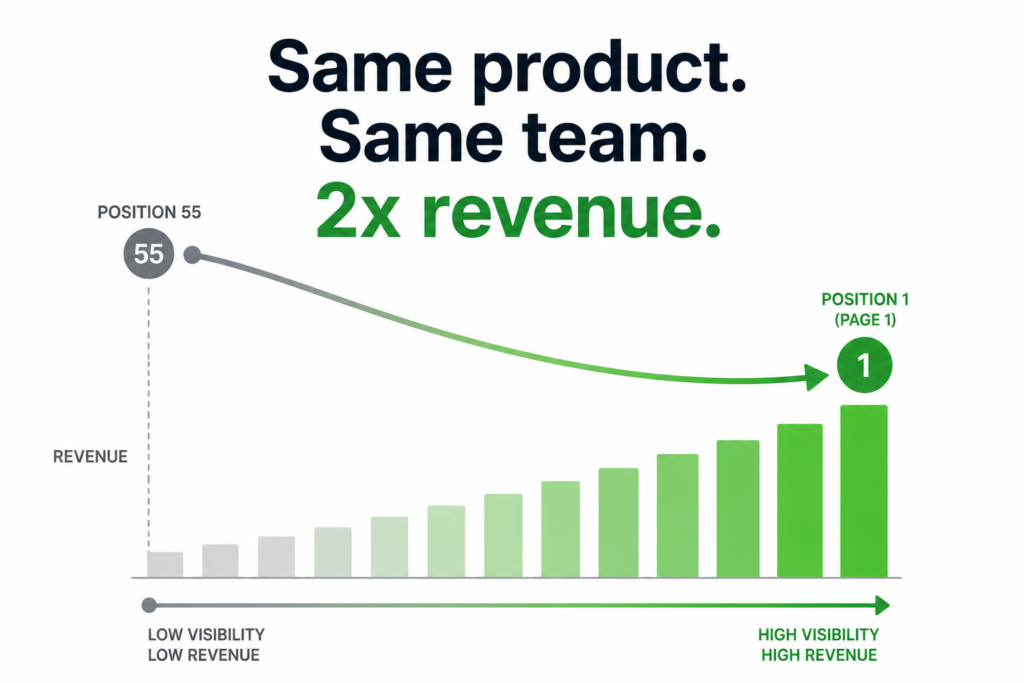
A team I worked with recently was publishing 40–50 pages per month. Consistently. For months. Their average keyword position was 55. Their organic traffic was flat. Their revenue hadn’t grown in 18 months.

The problem wasn’t effort. The problem was process.


The Content Volume Trap

Most content strategies are built on a flawed assumption: more content equals more traffic.

It doesn’t. More relevant, optimised, authoritative content equals more traffic. Volume without quality and structure is digital noise — it occupies your CMS without moving your rankings.

The team publishing 40–50 pages per month was generating content. They were not generating SEO-optimised content. The difference:

Generic ContentSEO-Optimised Content
Written for humans, not search intentBuilt around a specific keyword cluster
No target keyword or secondary keywordsPrimary + secondary keywords woven in naturally
No internal linking strategyDeliberate internal links to relevant pages
No structured dataSchema markup where applicable
Published and forgottenUpdated when ranking data shows opportunity

The same number of words. Completely different impact on rankings.


What the Automation Actually Changes

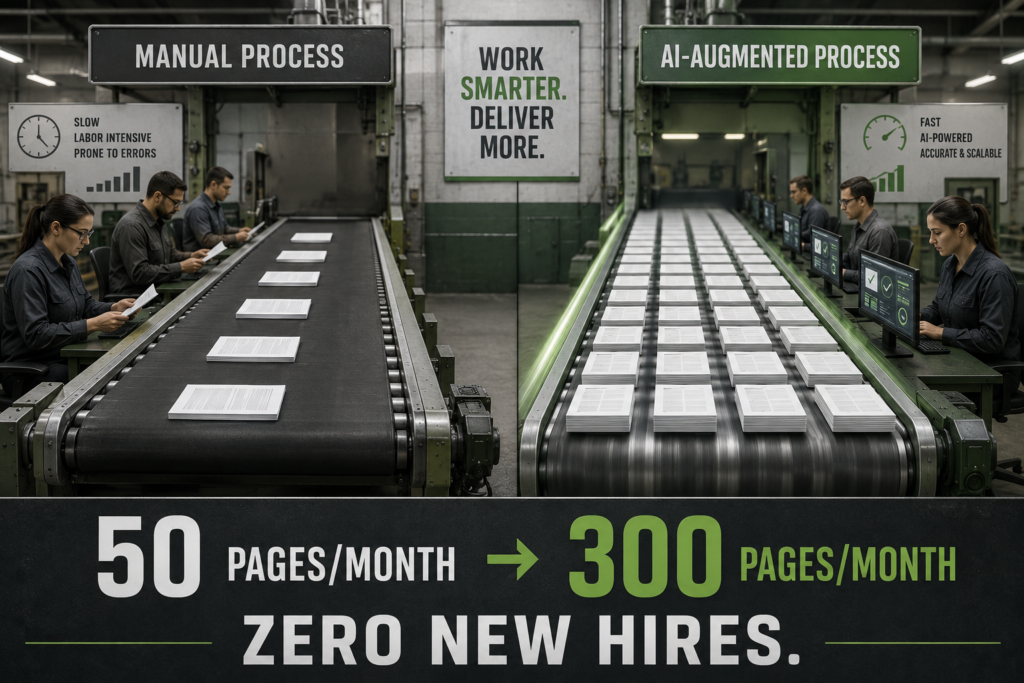
When I implemented an AI-driven content process for a previous client, the output went from 50 pages/month to 300 pages/month. Same team. No new headcount. The revenue impact was a 3–4x increase over the following 12 months.

Here’s specifically what changed:

Stage 1: Research (Previously: 4–6 hours per article. After: 20 minutes)

Before: A writer would manually research a topic, read competitor articles, identify relevant points to cover, and form an outline from scratch.

After: An AI agent processes the keyword brief, retrieves the top 10 ranking articles, identifies content gaps, extracts key entities and sub-topics, and produces a structured brief with a recommended outline — in 15–20 minutes.

The human’s job at this stage: review the brief, add brand-specific context, approve or refine the outline.

Stage 2: First Draft (Previously: 3–5 hours per article. After: 45 minutes)

Before: Writers produced full drafts from scratch, often starting from a blank page with only their outline.

After: The AI produces a structured first draft based on the approved brief. The draft is factually grounded (using retrieved source material), follows the brand’s tone guide, and incorporates keyword placement.

The human’s job: edit for accuracy, brand voice, and unique insight. This is where the real value-add happens — not the blank-page creation.

Stage 3: SEO Optimisation (Previously: 1–2 hours per article. After: 15 minutes)

Before: A separate SEO review step, often skipped under deadline pressure.

After: An automated layer checks keyword density, heading structure, internal link opportunities, meta description, and schema applicability before the draft goes to final review. Issues are flagged and suggestions are generated automatically.

Stage 4: Publishing and Linking (Previously: 30–60 minutes per article. After: Automated)

Before: Manual upload, formatting, image selection, category assignment, internal link insertion.

After: CMS integration handles upload and formatting. Internal linking is handled by a pre-built script that scans the site for relevant anchor text opportunities and inserts links programmatically.


The Output Quality Question

The first thing people ask when I describe this process: Is the quality good enough?

The honest answer: it depends on what you mean by quality.

If quality means “indistinguishable from long-form journalism written by a subject matter expert with 15 years of experience” — no, AI-augmented content at scale isn’t that.

If quality means “accurate, well-structured, keyword-relevant content that ranks well, answers searcher intent, and reflects the brand’s expertise” — yes, absolutely.

The client whose content I scaled from 50 to 300 pages saw a 3–4x revenue increase. The content was working. Readers were converting. Rankings improved. That’s the quality benchmark that matters for an e-commerce or content-driven business.

The additional advantage: with 300 pages published monthly instead of 50, you’re running 6x more SEO experiments. You discover which content types, angles, and keyword clusters perform fastest — and you can double down with data, not guesswork.


What the Process Actually Costs

Let me be direct about investment, because “AI will do everything for free” is not the reality.

A well-built content automation process typically requires:

Against an output of 300 optimised pages per month, the per-page production cost drops dramatically. More importantly, the revenue impact — when the content is SEO-structured and targeting real demand — dwarfs the tooling cost within 6–9 months.


Why Most Content Teams Aren’t Doing This Yet

Three reasons:

1. Process design is undervalued. Content teams optimise for writing skills, not workflow design. Building an AI-augmented content operation requires someone who thinks about systems, not just sentences.

2. The ROI timeline feels long. SEO results take 3–6 months to materialise. Teams that can’t connect content investment to revenue in the short term lose budget before the compounding kicks in.

3. “AI-generated content” carries stigma. This fades when you show results. A page that ranks #3 and converts at 2% doesn’t get penalised because an AI wrote the first draft. But the hesitation is real and slows adoption.


Start with One Process

You don’t need to automate everything on day one. Start with one content type — category pages, FAQ articles, or product guides — and build the brief-to-publish workflow for that type alone.

Measure the output quality and ranking results for 90 days. If it works (it usually does), expand to the next content type.

The brands that figure this out now will have a content infrastructure advantage in 24 months that will be expensive and time-consuming for competitors to replicate.


I design and implement content automation systems that scale output without scaling headcount. Currently open to new opportunities in content strategy, growth marketing, and digital operations. If you’re looking for someone who can build the process, not just the content — connect with me on LinkedIn or reach out at harish@psharish.com.

© PS Harish