A visitor asks a service assistant a question. The answer is useful. They decide to contact a specialist, open a form, and have to explain the whole requirement again.
That is an illustrative scenario, but it captures a product problem worth investigating: the answer improved while the journey stayed fragmented.
When I think about a website’s AI roadmap, I start with the task the customer wants to complete. I want to know where it begins, what information the person needs, and what happens after they receive an answer. That helps me decide where conversation earns its place and which foundations deserve investment first.
What should a website AI roadmap prioritize?
Start with one valuable customer task, identify where information or action breaks, and test whether conversational AI improves completion. Use approved information, appropriate context, and a reliable next step. Evaluate task success, answer quality, and operating cost before expanding.
The task may begin somewhere else
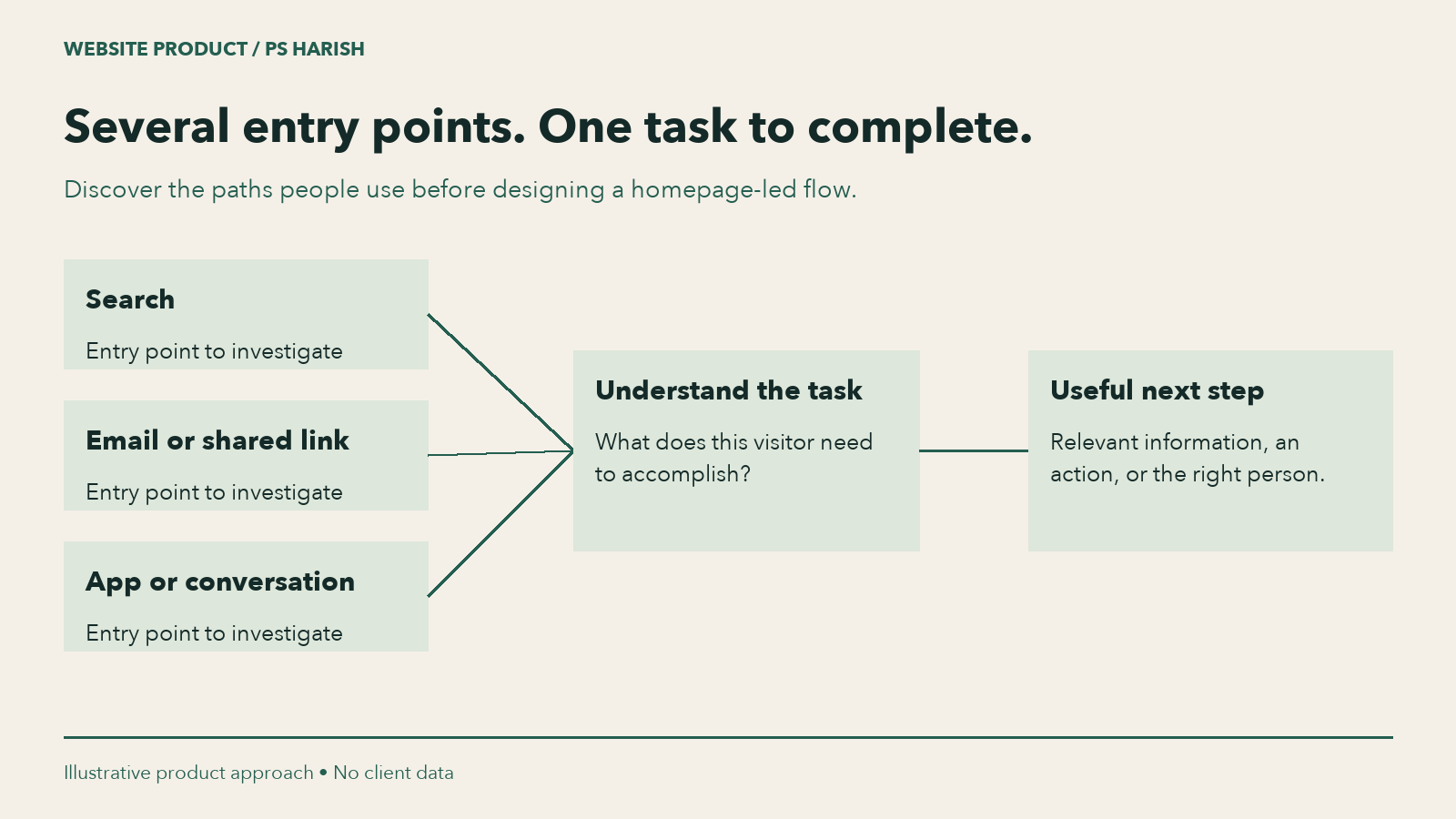
A customer might arrive from search, an email, an app, or a shared resource. They may enter through a detailed service page without seeing the homepage. They could also be gathering information through an interface the business does not control.
I would treat those entry points as discovery questions rather than assume every audience behaves the same way. Analytics, research, and conversations with customer-facing teams should tell us which paths matter.
The website still matters. It can provide authoritative information, let people evaluate options, and support actions that require the business’s systems. The product question is how well those capabilities serve the task, wherever the visitor starts.
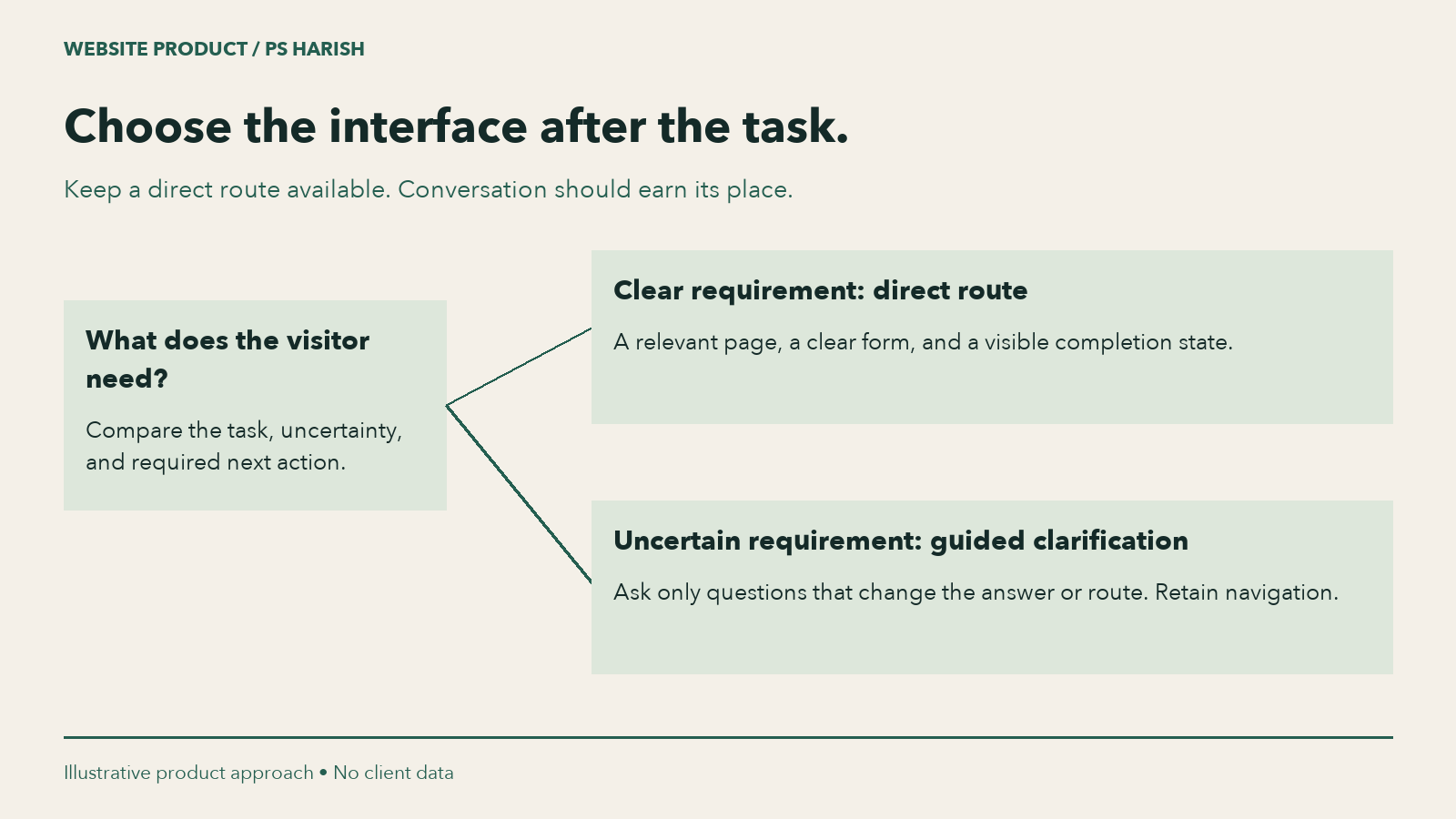
For example, someone arriving on a specialist service page may need help choosing between several capabilities. A customer who already knows what they need may simply want a direct enquiry route. Giving both the same conversation can add friction.
Choose a task before choosing an interface
I would begin with one valuable task whose current outcome can be observed. “Improve customer engagement” is too broad. “Help a prospective customer find a relevant service and reach the appropriate specialist” gives a team something to investigate and test.
I would ask business owners what a useful outcome looks like. Then I would observe how representative users approach it, examine search terms and drop-off points, and identify the handoffs between teams.
This is also where I would test whether conversation is needed. A clear page with an accessible form may solve a straightforward task more effectively. W3C’s forms guidance emphasizes understandable instructions, logical steps, and clear completion or error notifications—principles that remain useful whether AI is present or not. W3C Forms Tutorial
I would consider conversation when visitors struggle to express a need using the company’s categories, or when a small number of clarifying questions meaningfully changes the information they should see.
The initial scope would be narrow. That limits coverage, but it makes quality, cost, and customer outcomes easier to evaluate before expanding.
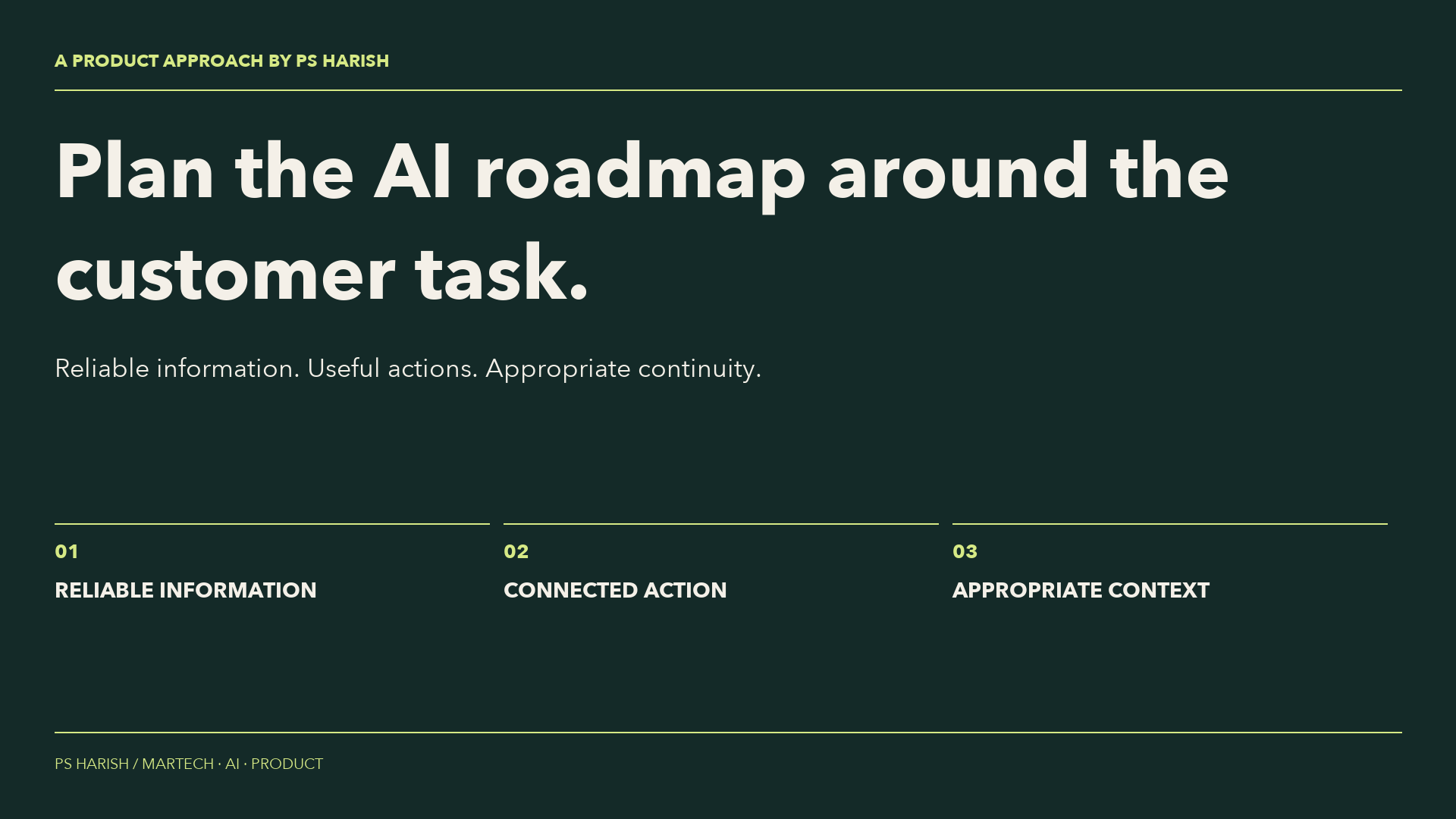
Three capabilities I would prioritize
Reliable information that can be reused
The assistant needs information with clear ownership and a maintenance process. I would identify approved sources, how they are updated, and who resolves conflicting statements.
Structured content can help information serve different experiences. It does not guarantee that an assistant will retrieve the right material or answer correctly. Retrieval and answer quality need evaluation with representative questions, including ambiguous and out-of-scope requests.
NIST’s generative AI risk profile identifies confidently incorrect output as a risk. I would therefore treat answer quality as a release criterion, alongside mechanisms for acknowledging uncertainty and offering an appropriate route to a person. NIST Generative AI Profile
A useful next action
After answering a question, what can the visitor do?
I would map the action explicitly. It might be viewing a relevant resource, comparing capabilities, requesting a conversation, or moving into an existing authenticated service.
An information assistant and a system authorized to execute a transaction have different requirements. The second needs permissions, confirmation, failure handling, and a reliable indication that the action completed. I would avoid promising an end-to-end transaction before the supporting service and integration are understood.
For a first pilot, an existing form or booking flow may be the right destination. A well-designed handoff can deliver value without replacing it.
Appropriate continuity
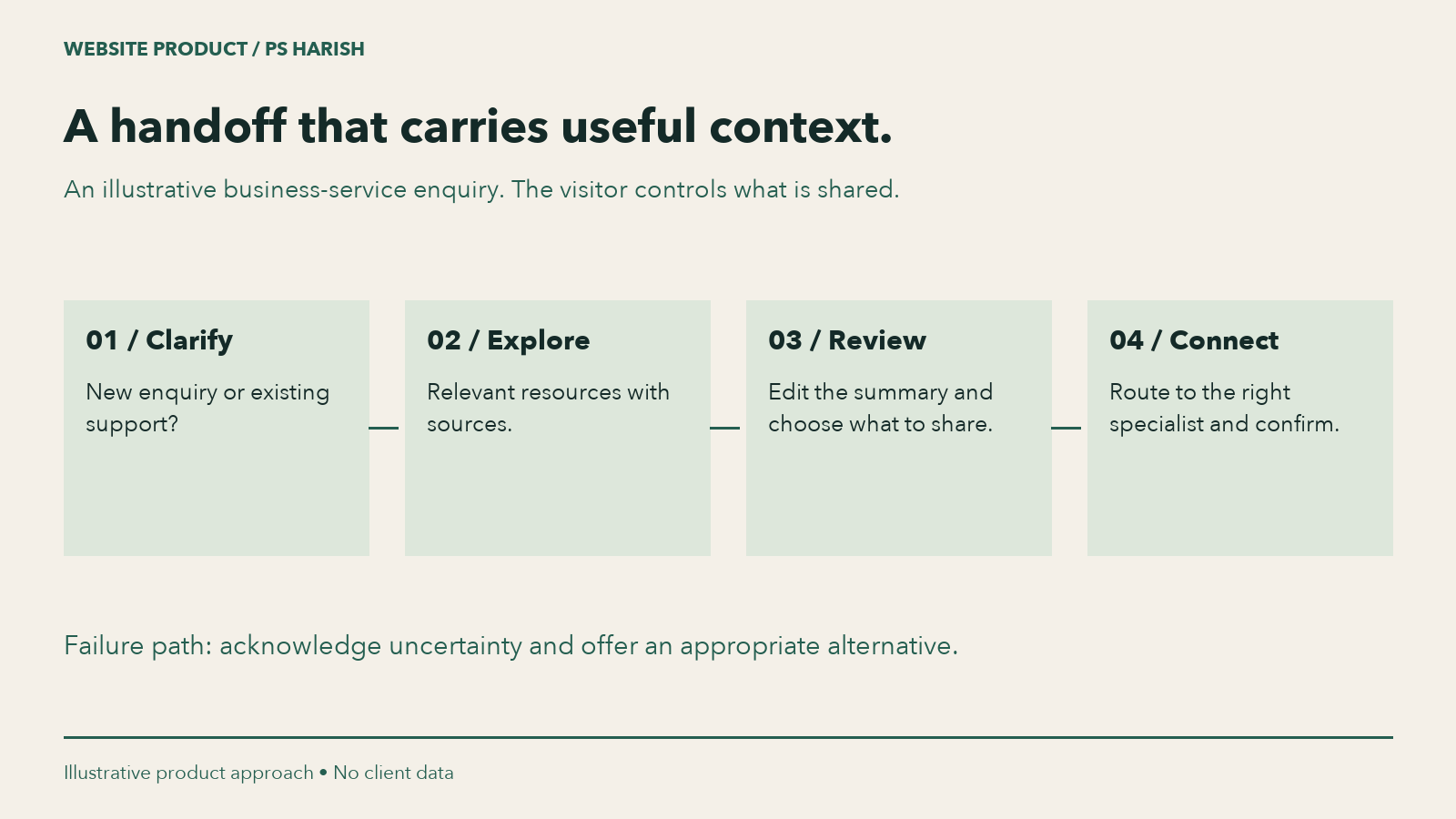
Within a conversation, users should not need to repeat information they just supplied. Before a specialist handoff, I would let the visitor review and edit the summary they want to share.
That does not require identifying every visitor at the start. I separate three things in requirements: audience context, current intent, and verified identity. Selecting a business-services section does not prove someone’s role. Recognizing a company does not grant access to its private records.
Cross-session or cross-channel continuity introduces additional questions about identifiers, permitted use, and ownership. I would assess those where the journey needs them rather than make a unified profile a prerequisite for every improvement.
One worked example: finding a business service
Consider an illustrative company with several technical service categories.
A visitor arrives from search and says, “We are planning a project across two regions. I need to understand what support you offer.”
The assistant first asks whether this is a new enquiry or support for an existing engagement. That distinction changes the route. For a new enquiry, it asks which area the visitor needs help with, then presents relevant approved resources and a short explanation of why each may be useful.
The visitor can explore those resources, refine the requirement, or contact a specialist. If they choose contact, the assistant presents a summary for review. Only then does the visitor submit the necessary contact details and agreed context.
The design also needs a failure path. If the available material cannot answer a question, the assistant should say so. If the visitor changes their mind, they should be able to revise the task. Conventional navigation remains available throughout.
For someone with a precise service requirement, I would retain a direct route. The purpose of conversation here is to reduce the work of translating an uncertain need into the right next step.
Let the journey inform architecture
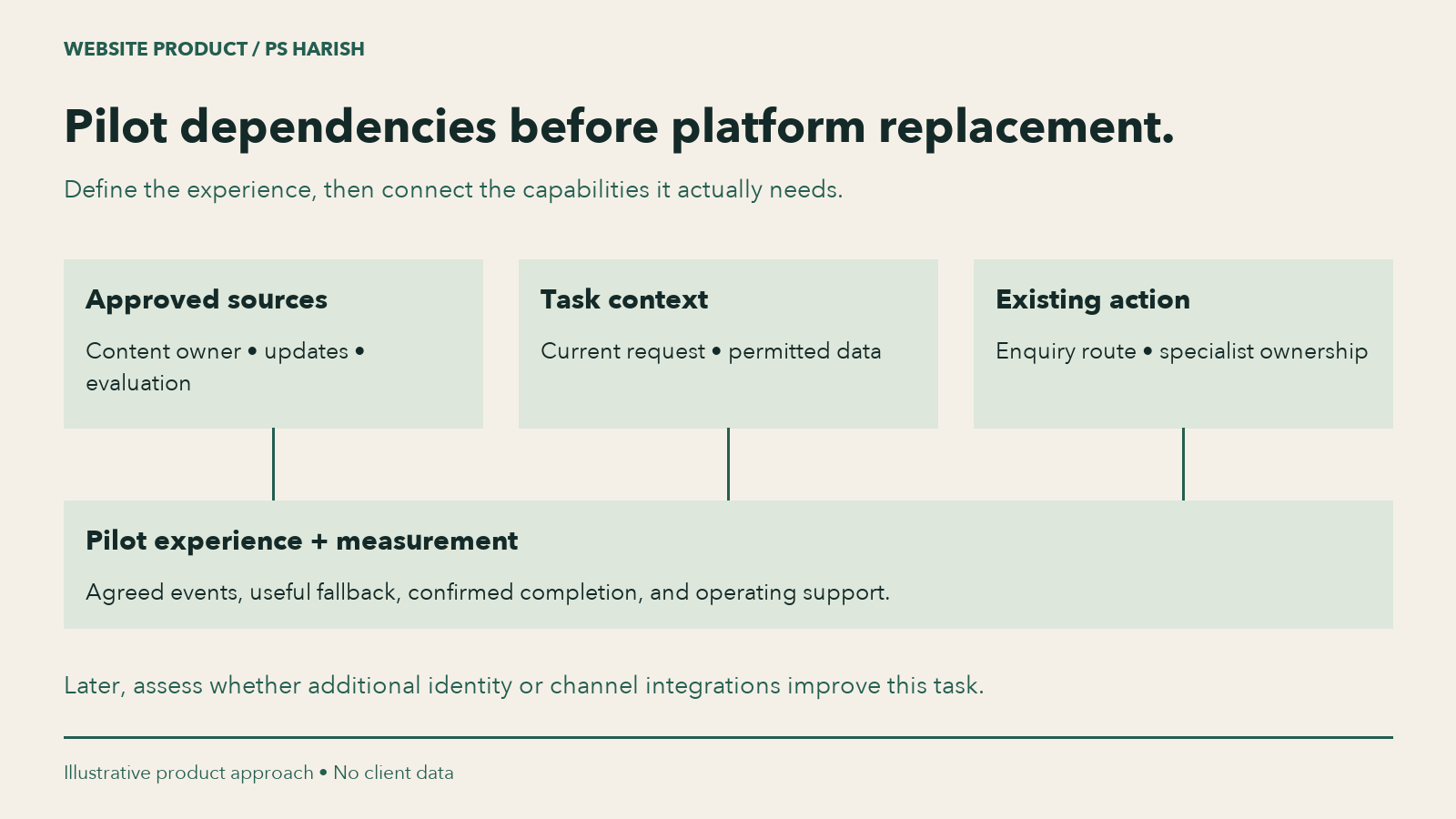
Once that experience is defined, the technical discussion becomes more concrete.
We can identify the content sources, required actions, event definitions, routing rules, and context that must pass between systems. We can also distinguish requirements for the pilot from capabilities useful only at a later stage.
I would first assess what the existing stack can support. Headless delivery may be useful when the same content and services need to serve several interfaces. It also introduces integration and operating responsibilities. A CMS replacement should follow an identified constraint and a comparison of options.
When I say the experience should be lightweight, I mean responsive interaction, bounded dependencies, and manageable operating cost. The business still needs ownership for content, changes, support, and measurement.
Measure completion, quality, and cost
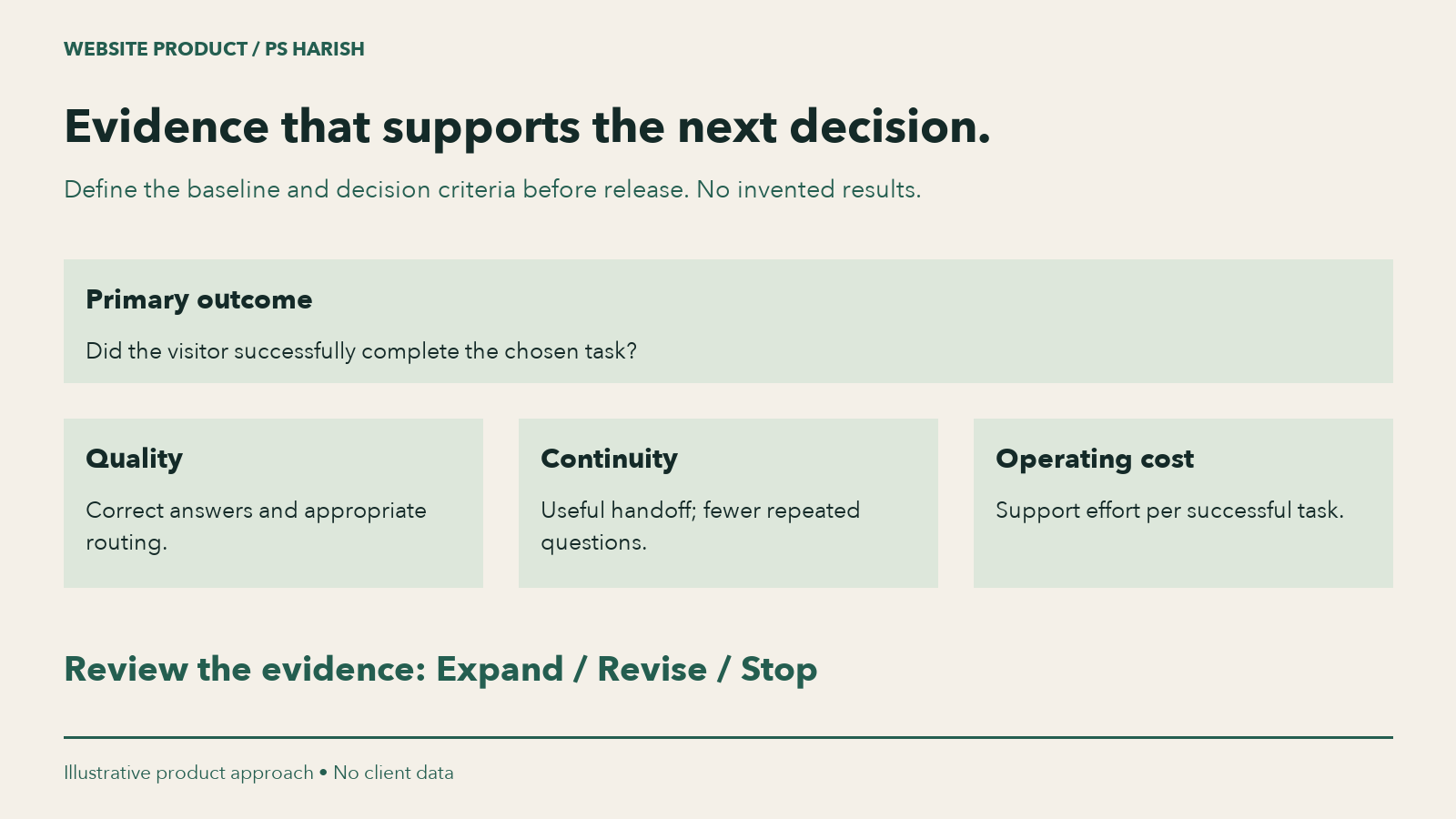
I would agree one primary outcome before release: successful completion of the chosen task.
For this example, that might mean visitors finding a relevant capability and reaching the appropriate specialist. A click alone would not prove the first outcome. Task-based testing and visitor feedback can help establish whether the information was useful.
I would pair that outcome with answer correctness, routing errors, repeated-question loops, abandonment, and operating effort. Downstream opportunity measures may be valuable where reliable linkage and attribution exist, but they should not be claimed prematurely.
Response speed is useful diagnostic information. Conversation volume shows usage. Neither alone proves that customers are better served.
The pilot should have a baseline, an appropriate comparison, and agreed criteria for expanding, revising, or stopping. I would look at cost per successfully completed task as well as quality. A pilot that looks good only because human teams quietly repair every failure is not ready to scale.
Where I would start
I would pick one valuable task and trace it from entry to completion. Then I would identify the point where information, action, or context breaks, and test whether conversation improves that point.
That gives the team a delivery decision it can learn from, rather than an open-ended commitment to put AI everywhere.
For the task you would choose first, is the main obstacle unreliable content, a disconnected action, or a handoff that loses context?
Questions about planning a website AI roadmap
Choose a task that matters to customers and the business, has observable friction, and can be tested within a bounded scope. Establish the current outcome before selecting an interface or platform. A useful starting point is a task where visitors struggle to find relevant information or reach the right team.
Test conversation when a visitor needs help clarifying a requirement or translating it into the company’s service categories. If the visitor already knows what they need, a clear page and direct form may be easier. Keep the conventional route available and compare successful task completion.
Let the visitor review and edit a short summary of their requirement, choose what to share, and submit it through an agreed route. Define who receives the request and how completion is confirmed. Verify that the receiving team gets useful context rather than assuming that sending a summary solves the problem.
Not necessarily. A visitor’s stated task and the current conversation can support a useful anonymous experience. Add reliable, permitted account or identity context where it improves the chosen journey. Do not make broader profile integration a prerequisite without establishing the need.
Start by assessing what the existing stack can support. Identify the content, actions, integrations, and measurement required for the pilot. Consider architecture changes only when a specific constraint and a comparison of options justify them.
Evaluate successful task completion alongside answer correctness, routing quality, repeated questions, and operating effort. Agree the baseline, comparison, and decision criteria before release. Expand when the evidence supports it; revise a fixable weak point or stop a use case that does not deliver enough value.