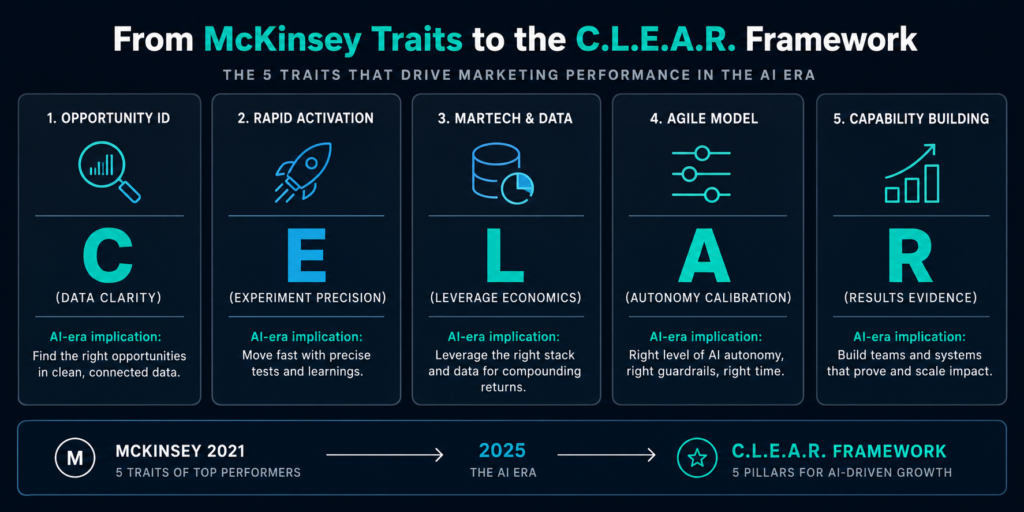
McKinsey identified 5 traits of personalization outperformers in 2021. Their January and July 2025 research confirms the pattern — and raises the stakes for every one of them.
The Pattern That Separates the Leaders
After a decade of personalization research, McKinsey’s conclusion was unambiguous: the companies generating the most value from personalization don’t just have better tools or bigger budgets. They organize differently, measure differently, and make decisions differently.
In their 2021 Next in Personalization report, McKinsey identified five behaviors that consistently characterize personalization outperformers. Companies that apply all five generate 40% more revenue from their marketing activities than average peers. Across US industries, the gap between top-quartile and average personalization performance represents over $1 trillion in unrealized value.
Their January 2025 McKinsey Quarterly update confirmed the same pattern holds in the gen AI era — and added new proof points. A North American retailer that built its data and decisioning infrastructure correctly generated $400M in pricing value and $150M from gen AI–targeted offers in one year. A European telecom that instrumented its personalization properly saw 10% higher engagement from AI-personalized messages. These aren’t outliers — they’re the playbook of the five traits in action.
Then in July 2025, McKinsey partner Eli Stein noted at Cannes Lions that the majority of CMOs are now using AI — but almost entirely in “isolated, one-off use cases” generating “modest results.” The five traits are what separate the companies with isolated wins from the ones compounding at scale.
Five years on, with AI having fundamentally changed what’s possible — and what’s at risk — each of those five behaviors has taken on new urgency.
Here is what they look like in practice, reframed for the AI era.
1. They See the Opportunity Before They Build the Solution
McKinsey calls this Opportunity Identification — building a granular view of where personalization creates the most value across the customer lifecycle, before investing in any specific capability.
In 2021, this meant segmenting your customer base, modeling lifetime value, and identifying the moments where a more relevant experience would change behavior. Good work. Often skipped.
In 2026, with AI generating output at scale, skipping this step is catastrophic. An AI personalization engine with no defined target will generate personalized content, emails, and recommendations at high volume — all pointed at the wrong outcomes. Faster noise is still noise.
What leaders do: Before any AI deployment, they define which specific customer behaviors they are trying to change, in which segments, across which channels. They quantify the value of changing those behaviors. Then they build backward from those outcomes.
This maps directly to the C in the C.L.E.A.R. framework — Clarity of Data. You cannot identify the right opportunities without first understanding what your data can actually reveal. The audit precedes the strategy.
2. They Activate Narrowly Before They Scale Broadly
McKinsey describes this as Rapid Activation and Optimization at Scale — AI-driven decisioning capabilities that respond to customer signals in real time, powered by predictive models and robust measurement processes.
In 2021, this was aspirational for most organizations. The infrastructure required was significant. In 2026, the tools are accessible. The failure mode has shifted: companies now have access to real-time decisioning engines and activate them across every channel simultaneously on day one — before they’ve proven the underlying hypothesis works in a single channel.
What leaders do: They run narrow experiments first. One segment. One message. One measurable metric. They prove the logic before they scale the machinery. Activation is rapid not because it’s broad, but because the hypothesis is precise enough to test quickly.
This is the E in C.L.E.A.R. — Experiment Precision. The fastest path to scale is a narrow experiment that generates unambiguous evidence. A broad launch that generates ambiguous data is not a faster path — it’s a dead end with a long delay before you realize it.
3. They Build MarTech for Outcomes, Not for Coverage
McKinsey identifies Martech and Data Enablement as a core trait — but with a specific qualifier: leaders don’t let “a thousand flowers bloom.” They identify a specific set of customer outcomes and build their MarTech stack backward from those outcomes.
This was contrarian advice in 2021, when the dominant approach was to accumulate tools and integrate later. It’s essential advice in 2026, when AI layers are being added on top of already-fragmented stacks — amplifying the fragmentation rather than resolving it.
What leaders do: They ask “what decision do we need to make, and what data does that decision require?” before they evaluate any tool. Their MarTech architecture is defined by the customer journey they’re trying to influence, not by the vendor landscape.
This is the L in C.L.E.A.R. — Leverage Economics. Every tool in the stack has a build cost, an operating cost, and a maintenance cost. Leaders apply a rigorous economic filter to each addition. The question is never “what can this tool do?” It’s “does this tool improve the economics of a specific outcome we’ve already committed to?”
4. They Earn Autonomy Through Evidence
McKinsey’s fourth trait is an Agile Operating Model — cross-functional teams running hundreds of tests per year, with a hub-and-spoke structure where each hub owns specific elements of the personalization journey.
In 2021, agility in this context meant faster campaign cycles and cross-functional collaboration. In 2026, it means something more specific: the discipline to expand AI autonomy gradually, based on a demonstrated track record, rather than granting full autonomy to new systems on day one.
What leaders do: They start with AI-assisted decisions — where the human remains in the loop — and shift toward AI-autonomous decisions as accuracy is proven. They log where the AI was right and where it wasn’t. They use that evidence to set the threshold for expanded autonomy. They run more tests per year not because they have more resources, but because each test is narrow enough to complete and measure quickly.
This is the A in C.L.E.A.R. — Autonomy Calibration. The Change Delta between how people work today and how an AI expects them to work determines whether the system gets adopted or abandoned. Leaders manage that delta consciously.
5. They Prove It Before They Pitch It
McKinsey’s fifth trait is Capability Building — a data-driven approach to developing the organizational skills needed to sustain personalization at scale. Digital acumen, advanced analytics, performance marketing, product management.
In 2021, this was about hiring and training. In 2026, it’s also about credibility. The organizations building durable personalization capability are the ones generating evidence that justifies continued investment — not just in tools, but in the people and processes around them.
What leaders do: They document results with precision. They establish baselines before interventions. They define what “success” looks like before a campaign launches, not after it ends. When they go to leadership for additional investment, they bring evidence — not impressions.
This is the R in C.L.E.A.R. — Results Evidence. The teams that sustain personalization investment over time are the teams that can prove, with specificity, what moved and why. Activities consume budget. Evidence unlocks it.
The Framework, Mapped
McKinsey Outperformer Trait C.L.E.A.R. Equivalent The AI-Era Urgency Opportunity Identification C — Clarity of Data AI amplifies the wrong target as fast as the right one Rapid Activation at Scale E — Experiment Precision Broad activation without precision produces expensive noise Martech & Data Enablement L — Leverage Economics AI layers on fragmented stacks deepen fragmentation Agile Operating Model A — Autonomy Calibration Autonomy granted without evidence gets abandoned Capability Building R — Results Evidence Investment sustains where evidence exists What This Means for You
McKinsey’s research makes one thing clear: the organizations winning at personalization are not the ones with the most sophisticated AI. They’re the ones who have built the operational infrastructure that makes AI effective.
The five traits are not sequential. They reinforce each other. Data clarity enables precise experiments. Precise experiments generate results evidence. Results evidence justifies expanding autonomy. Expanded autonomy, applied to a well-designed MarTech stack, unlocks the scale that drives 40% more revenue.
The C.L.E.A.R. framework is the practical translation of this research into a 30-day operational discipline. Not a multi-year transformation roadmap. A structured sprint designed to prove — or eliminate — one AI personalization hypothesis at a time.
The leaders who are pulling ahead aren’t moving faster than everyone else. They’re moving more precisely. Start narrow. Measure honestly. Scale what works.
Apply the full C.L.E.A.R. framework to your next personalization initiative
I’ve applied all five of these traits across 3 live personalization implementations — from data audit to measurable revenue impact. I’m available to take on personalization as a project engagement or a full-time role. If you’re ready to move from isolated AI experiments to compounding results, let’s talk on LinkedIn or email harish@psharish.com.
By PS Harish
19 August 2026Comments
No comments yet.



Leave A Comment