The AI Adoption Crisis No One Is Talking About
The most costly mistake I see in boardrooms today isn’t a bad technology choice. It’s a misdiagnosis.
Executives are treating AI as an IT problem — a race to license the latest model, debate version numbers, and stand up a chatbot. Meanwhile, their operations stay exactly the same. Capital burns. Projects stall. And when the results don’t materialize, the conclusion is usually “AI wasn’t ready” — when the truth is, the organization wasn’t.
After advising dozens of companies through AI transformations, I’ve found that success has almost nothing to do with which model you use. It has everything to do with whether you’ve built the operational conditions for AI to deliver measurable results.
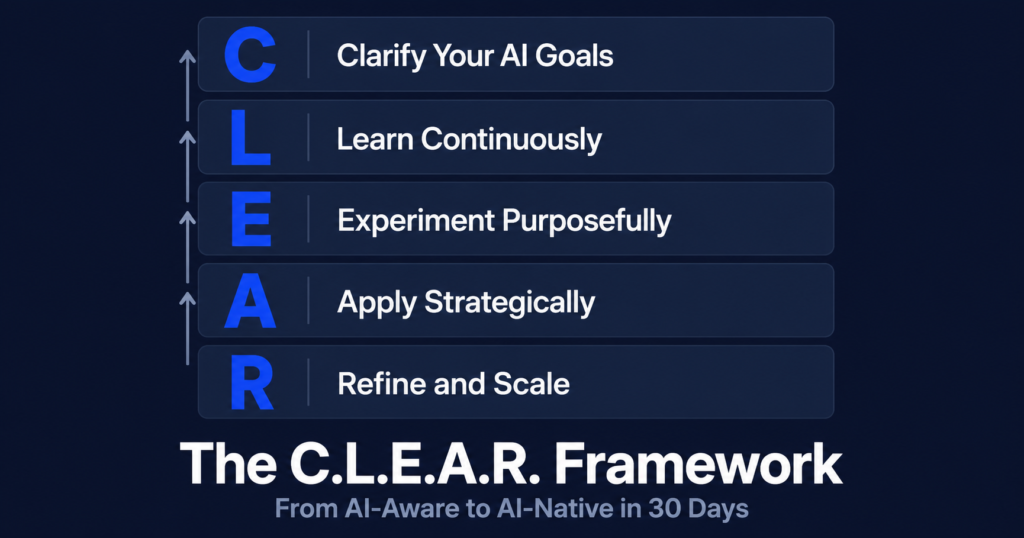
The C.L.E.A.R. framework is the structured approach I use to create those conditions — moving organizations from buzzword chasing to a disciplined, evidence-based path to ROI.
The Four Failure Modes Before We Begin
Before introducing the framework, it’s worth naming what it’s designed to correct:
The IT Trap. Delegating AI transformation entirely to the technology team. AI is an operational optimization tool. It must be led by the business leaders who own the outcomes — not handed off to those who own the infrastructure.
Version Obsession. Debating model versions instead of building the proprietary workflows that make any model useful. The competitive moat is never the model — it’s what you teach it to do.
Metric Vagueness. Launching initiatives with goals like “improve efficiency” that can never be proven or disproven. Without a historical benchmark and a defined measurement window, you have an activity, not an experiment.
Scope Creep. Attempting to automate everything at once. AI experiments that try to boil the ocean produce nothing measurable. Precision is the prerequisite for proof.
C — Clarity of Data
The “Seen” Requirement
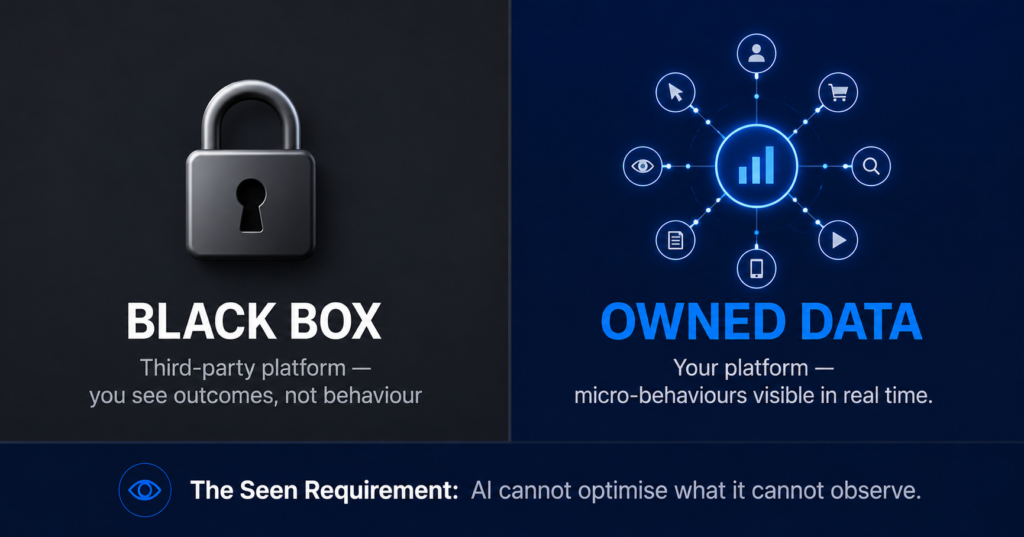
The prerequisite for any AI initiative is visibility. An AI cannot optimize what it cannot observe.
Data Clarity means your system has access to clean, granular, and historical data before the experiment begins. Without it, you are not running an AI project — you are running a hope project.
The critical question founders must ask: Do you own your data, or does a platform own it for you?
Consider an online furniture retailer selling through both their own website and a third-party marketplace. On the marketplace, they see units sold — nothing else. No session data. No configuration tool interactions. No indication of why customers didn’t buy.
On their own site, the AI can observe that 61% of customers who use the sofa configuration tool abandon when they reach the delivery date selector — not because of price, but because lead times exceed six weeks. That single behavioral data point points to a supply chain fix. No amount of discount testing on the marketplace would ever surface it.
The same dynamic plays out in B2B. A project management SaaS company can see every click inside their platform — feature usage, session depth, drop-off points. But the outcome their customers actually care about (whether projects are delivered on time) lives in the customer’s own systems, invisible to the AI. Knowing the boundary of your data visibility determines where AI can genuinely help versus where it’s operating blind.
Data Visibility Checklist
- Ownership — Do you own the primary data source, or are you dependent on a third-party platform?
- Granularity — Can the system observe specific micro-actions (time on page, search queries, drop-off points)?
- Historical depth — Is there at least 90 days of clean, structured data to establish a baseline?
- Accessibility — Is the data formatted and accessible for analysis, or siloed across disconnected systems?
Data visibility is the foundation. But visibility is a cost center unless the economics behind your initiative actually hold.
L — Leverage Economics
The Three-Cost Filter
Technical feasibility is the lowest bar to clear. Economic rationality is the highest — and most AI projects never clear it.
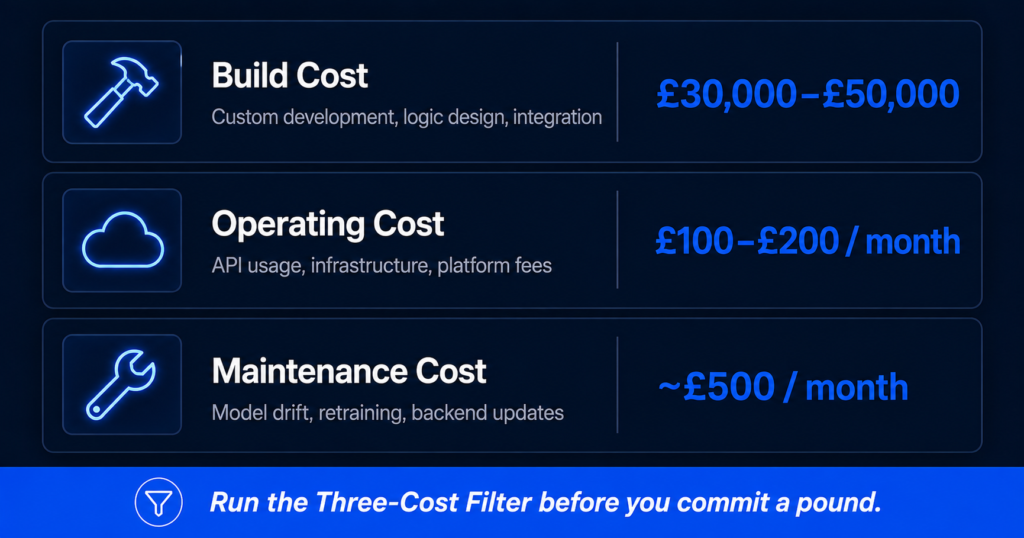
Every use case must be subjected to what I call the Three-Cost Filter: evaluating Build Cost, Operating Cost, and Maintenance Cost against the value the AI actually replaces or creates.
Cost Category Description Typical Range Build Cost Custom development, logic design, and initial integration £30,000 – £50,000 Operating Cost Recurring API usage, server infrastructure, platform fees £100 – £200 / month Maintenance Cost Model drift management, retraining, and backend updates £500 / month When the Economics Fail: A Law Firm
A 200-person law firm wants to automate contract review. Their team processes 80 contracts per month, currently handled by two senior associates billing at £180/hour. An AI could technically extract key clauses, flag anomalies, and produce a first-pass summary.
Should they build it? No.
At a build cost of £45,000 and £600/month in maintenance, the per-contract cost of the AI system at 80 monthly contracts exceeds what the associates cost. The volume doesn’t justify the capital. The associates can be redeployed; the AI system cannot be scaled down.
When the Economics Win: An Insurance Company
An insurance company processing 8,000 claims per month faced a different calculation. Their manual triage process — routing each claim to the right adjuster based on claim type, value, and complexity — took an average of 47 minutes per claim and introduced significant routing errors.
Same build cost range. But at 8,000 monthly transactions, a 14% improvement in routing accuracy eliminated £290,000 in annual rework costs. The system paid for itself in under four months.
The pattern is consistent: AI economics require either high transaction volume, significant error-reduction value, or both. Run the Three-Cost Filter before committing a pound.
E — Experiment Precision
From Prompt Engineering to Skill Logic
“Increasing retention by 20%” is not an experiment. It’s a wish.
Strategic AI success comes from narrowing scope to the point where the outcome is binary and measurable. This is the shift from asking AI questions to encoding AI with logic — what I call a Skill File.
A Skill File is a structured document (written in plain Markdown) that encodes a specific, repeatable workflow. Instead of prompting the AI to “help with customer retention,” you give it a conditional logic path it can execute consistently.
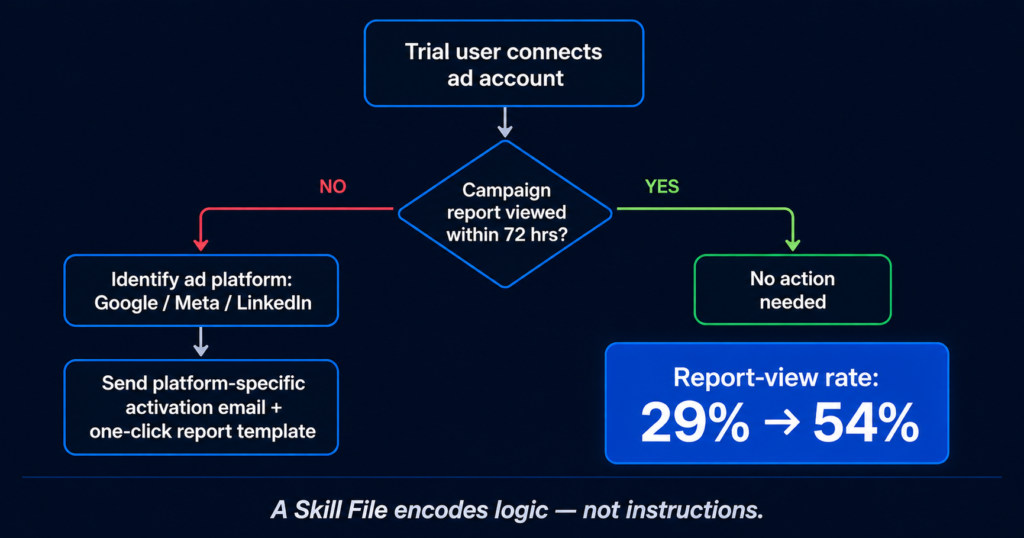
Here’s what that looks like in practice. A B2B SaaS company offering a marketing analytics platform had a trial-to-paid conversion problem. “Improve conversion” was their goal. Too vague to act on. The hyper-specific hypothesis: trial users who connect their ad account but don’t view a campaign report within 72 hours churn at 3× the rate of those who do.
The Skill File encoded one workflow:
If trial user → connected ad account → no campaign report viewed → Day 2 → identify their primary ad platform (Google / Meta / LinkedIn) → send a platform-specific activation email with a one-click pre-built report template for their account.
Not a campaign. A conditional workflow with a single measurable output: did the 72-hour report-view rate move?
It did — from 29% to 54% over a six-week test. That one metric determined whether the hypothesis was worth scaling.
The fastest way to build Skill Files is through a Watch Phase: record actual human workflows — screen captures, process walkthroughs, spoken explanations from your top performers — and distill that tribal knowledge into structured logic. The best Skill Files aren’t written by AI teams. They’re extracted from the people already doing the job well.
Experiment Precision Checklist
- Is the hypothesis hyper-specific? (One behavior → one outcome)
- Is the success metric unambiguous? (A number that moves or doesn’t)
- Is the workflow documented well enough to encode into structured logic?
- Is there a defined 30-day measurement window?
A — Autonomy Calibration
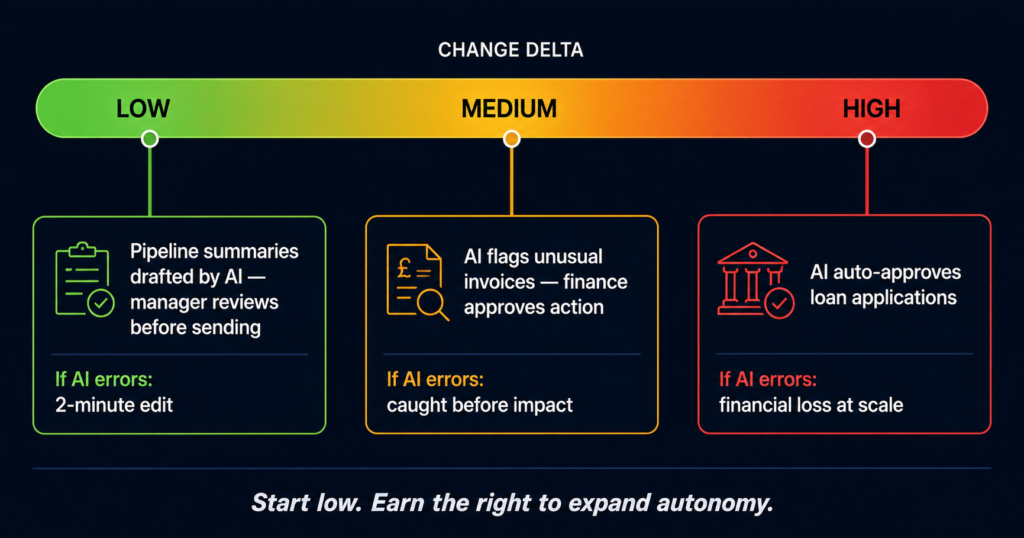
The Change Delta Principle
The most expensive AI projects I’ve seen fail didn’t fail because the technology didn’t work. They failed because the people who had to use them didn’t.
Every AI initiative creates a Change Delta — the gap between how people work today and how the AI expects them to work. A high Change Delta means a painful, friction-heavy transition. That friction is where multi-million pound projects go to die.
For initial deployments, the goal is Low Delta, High ROI: choose use cases where the AI enhances an existing workflow rather than replacing it wholesale.
Risk Level Example If the AI Errors Low — start here AI drafts weekly pipeline summaries for sales managers to review and send Manager edits the draft — no harm done, zero customer impact Medium — human in loop AI flags invoices above £10k with unusual patterns for finance team review Human approves action before anything happens — error caught before it lands High — prove first AI auto-approves or rejects SME loan applications under £25k Wrong approval at scale = material financial loss with no human checkpoint The rule is simple: begin where an AI error is recoverable, and earn the right to expand autonomy through demonstrated accuracy.
A sales manager spending two minutes editing an AI-generated summary costs nothing. An auto-rejected loan application costs a customer, a relationship, and potentially a regulatory fine. The Change Delta between those two scenarios isn’t just about risk — it’s about how much your team has to change how they work. Low-delta deployments get adopted. High-delta ones get abandoned.
As confidence builds through low-delta wins, AI can take on more autonomous roles — initiating multi-step workflows, making routing decisions, operating with minimal human review. But that autonomy is earned through a track record, not assumed on day one.
R — Results Evidence
Measuring What Actually Moved
“Efficiency improved” is not a result. A result is a specific metric that moved from point A to point B, with a documented before-state and an auditable after-state.
This sounds obvious. It rarely happens in practice.
Case Study: B2B Customer Support
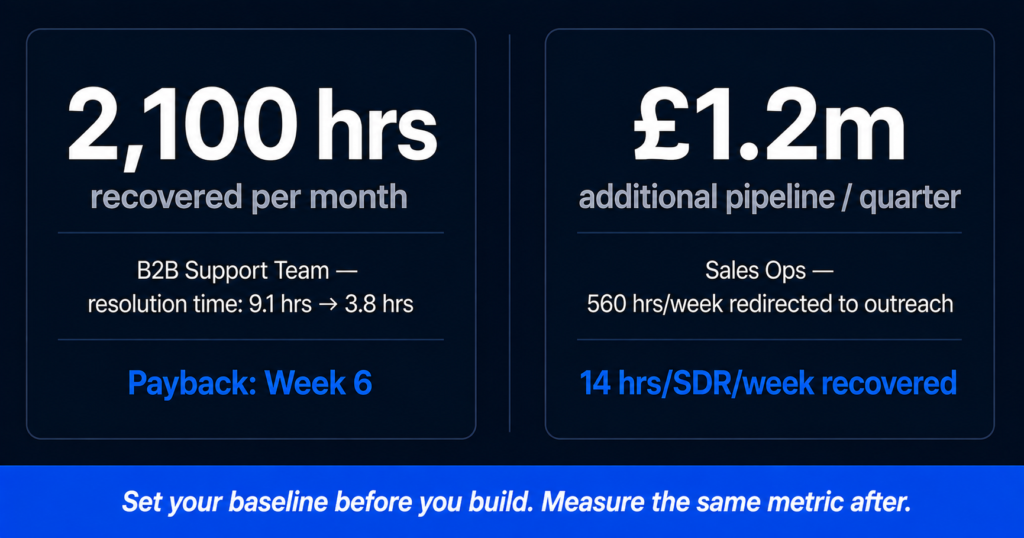
A software company’s support team was handling 310 tickets per day. Average resolution time: 9.1 hours. Before any AI intervention, they documented this baseline for 30 days — ticket volume, resolution time, and category distribution.
They deployed an AI triage system that classified incoming tickets by type and routed them to the specialist best positioned to resolve them. No new hires. No workflow overhaul. The AI inserted itself into the existing queue as a routing layer.
After 30 days: average resolution time dropped to 3.8 hours — a 58% reduction. Across their 14-person support team, that recovered approximately 2,100 hours per month.
At a fully-loaded staff cost of £38 per hour, the recovered capacity was worth £79,800 per month. Against a build cost of £42,000 and £650/month in operating costs, the system reached payback in week six.
The result wasn’t “improved customer experience.” It was 2,100 hours and £79,800 — measured against a 30-day baseline, auditable by anyone who asks.
Case Study: Sales Operations
A 40-person sales team was spending an average of 35% of their working week on CRM hygiene — logging call notes, updating deal stages, and manually entering contact data after meetings.
An AI system trained on call transcripts and email threads automated CRM updates in real time. Each SDR recovered approximately 14 hours per week. Across the team, that was 560 hours per week redirected to outreach.
In the following quarter, outbound activity increased by 31% with no additional headcount. Pipeline generated grew by £1.2m. The AI didn’t close deals. It gave the people who close deals their time back.
The Zero-Dev Deployment Principle
One barrier to gathering evidence quickly is the development queue. Traditional feedback loops — build a tool, wait for IT to deploy it, collect data, wait for a report — can stretch a 30-day experiment into a 6-month one.
Where possible, use lightweight, no-code or low-code approaches to deploy internal dashboards and measurement tools directly from your AI environment. The faster you can close the evidence loop, the faster you know whether to scale or pivot.
Your 30-Day AI Audit
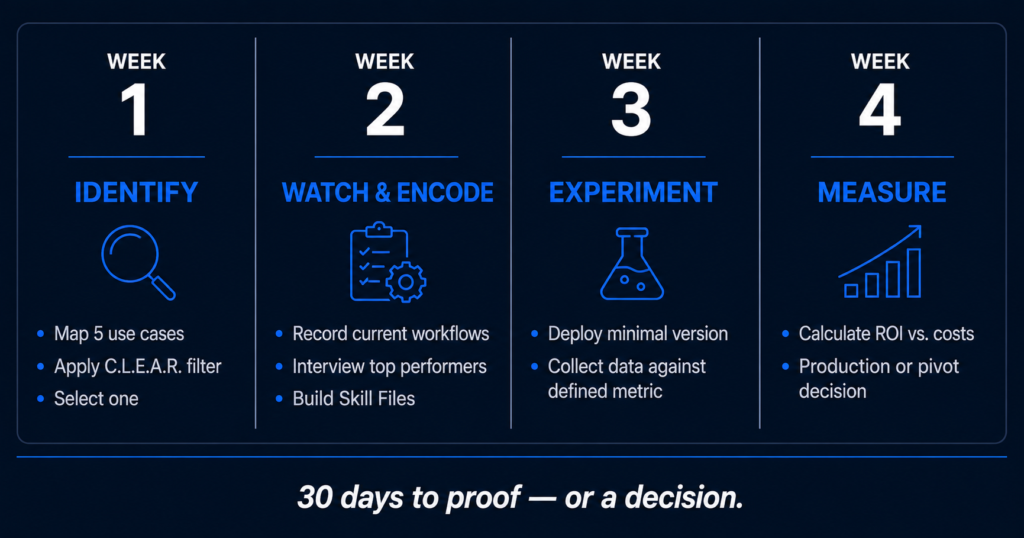
The C.L.E.A.R. framework isn’t a multi-year transformation roadmap. It’s a disciplined 30-day sprint designed to generate proof — or to eliminate a bad idea before it consumes your budget.
| Week | Phase | Key Activities |
|---|---|---|
| Week 1 | Identify | Map 5 high-impact use cases. Apply the C.L.E.A.R. filter to each. Select one. |
| Week 2 | Watch & Encode | Record current workflows. Interview top performers. Build Skill Files from the tribal knowledge. |
| Week 3 | Experiment | Deploy a minimal working version. Collect behavioral data against your defined metric. |
| Week 4 | Measure | Calculate ROI against full build and operating costs. Make a production/pivot decision. |
Founder’s Audit Checklist
- Clarity — Do we own the data this experiment requires?
- Leverage — Do the Three-Cost economics support a positive ROI at realistic volume?
- Experiment Precision — Is the hypothesis specific enough to be proven or disproven in 30 days?
- Autonomy — Is the Change Delta low enough for the team to adopt without friction?
- Results — Do we have a historical benchmark to prove the AI moved the needle?
The Real Race
The organizations winning with AI aren’t the ones with the biggest model budgets or the most ambitious transformation visions. They’re the ones who ran a narrow experiment, measured it honestly, and built from there.
The C.L.E.A.R. framework exists to give you the discipline to do exactly that — to move from AI-aware to AI-native one evidence-based step at a time.
The question isn’t whether AI is ready. The question is whether your organization has built the conditions for it to succeed.
Harish is a Strategic AI Transformation Consultant and CTO Advisor helping growth-stage companies move from AI experimentation to operational ROI. Connect on LinkedIn or reach out at harish@psharish.com.
By PS Harish
9 August 2026Comments
No comments yet.



Leave A Comment