Most companies treated personalization as a technology gap. AI proved it was always an operational one.
The Expectation Was Set Without Your Permission
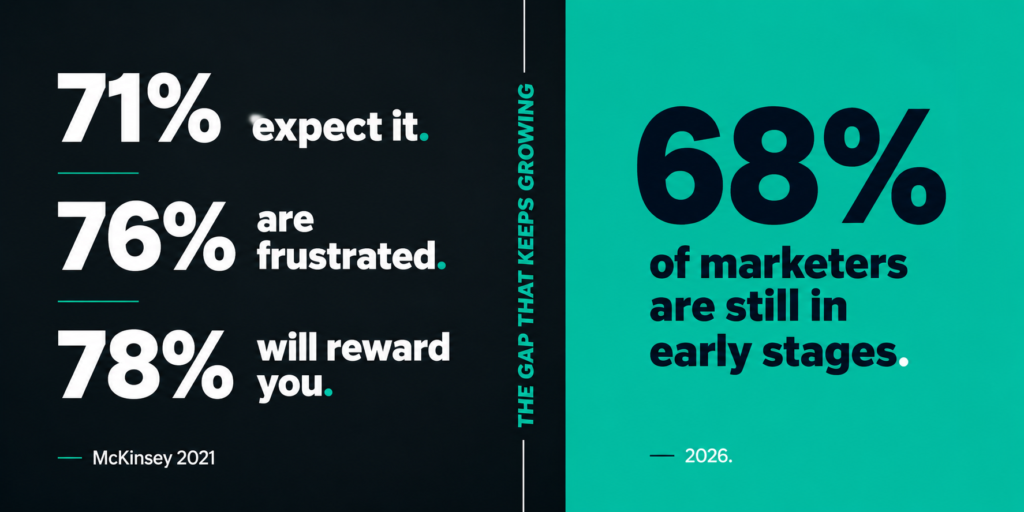
In 2021, McKinsey published what should have been a wake-up call for every marketing leader: 71% of consumers expect personalized interactions from the brands they engage with. 76% get frustrated when they don’t get it.
That was five years ago.
Since then, AI has made personalization technically easier than at any point in history. Natural language processing, behavioral prediction models, real-time decisioning engines — tools that once required a team of data scientists now ship as out-of-the-box features in most MarTech stacks.
And yet, in 2026, 68% of marketers are still in the early stages of AI personalization implementation (StackAdapt). Only 1 in 5 brands have fully integrated AI across their customer touchpoints. A mere 15% of companies have achieved genuine cross-channel personalization.
McKinsey’s own July 2025 research confirms the stall. In an interview at Cannes Lions, McKinsey partner Eli Stein — one of the authors of the original 2021 report — noted that while most CMOs have moved beyond pure experimentation, they’re now using AI only in “isolated, one-off use cases,” generating “modest results: some cost savings, incremental growth, but nothing transformative.” And separately, McKinsey’s January 2025 Quarterly found that over 75% of consumers are turned off by content that doesn’t feel relevant — a bar that keeps rising as AI makes relevance cheaper to deliver.
The technology got easier. The gap got wider.
This is the paradox I encounter in almost every MarTech engagement I take on: companies with sophisticated tool stacks delivering generic experiences at scale, while their customers quietly switch to whoever treats them like an individual.
Why the Gap Is Growing, Not Shrinking
Here’s what I’ve observed after working across dozens of MarTech transformations: the personalization problem was never a technology problem. It was always an operational one.
Companies buy personalization tools before they’ve built the conditions for those tools to work. They license AI platforms before they’ve audited what data those platforms can actually access. They launch personalization campaigns before they’ve defined what “personalized” means for their specific customer — and how they’ll know if it worked.
The result is predictable: AI sits on top of a broken foundation and produces outputs that are technically “personalized” but practically irrelevant. A customer who viewed three properties in one city gets retargeted with listings in another. A trial user who signed up for a B2B platform gets an onboarding email written for a completely different use case. A repeat buyer gets treated like a first-time visitor.
These aren’t technology failures. They’re operational failures — and no AI upgrade will fix them.
What the Data Actually Tells Us About the Stakes
The McKinsey research doesn’t just describe the consumer expectation gap. It quantifies what’s on the other side of closing it.
78% of consumers are more likely to repurchase from companies that personalize. 78% are more likely to recommend those companies to friends and family. 76% are more likely to consider purchasing in the first place.
That’s not a marginal lift. That’s a flywheel. Every personalized interaction generates more data. More data enables better personalization. Better personalization drives higher lifetime value, stronger retention, and more referrals — without additional acquisition spend.
Companies that lead in personalization generate 40% more revenue from their marketing activities than their average peers. Across US industries, McKinsey estimates that shifting to top-quartile personalization performance would unlock over $1 trillion in value.
That number isn’t theoretical. It’s sitting in your customer data right now, waiting for the operational conditions to release it.
The Real Question Isn’t “Which AI Tool?”
Every conversation I have with marketing leaders eventually arrives at the same question: “Which AI tool should we be using for personalization?”
It’s the wrong question.
The right question is: “Have we built the operational conditions for any AI tool to work?”
Before a personalization AI can deliver relevant recommendations, it needs clean, accessible, granular behavioral data. Before it can optimize in real time, it needs a defined hypothesis to test against. Before it can scale, it needs a team that trusts it enough to let it operate — and that trust is earned through low-stakes wins, not high-ambition launches.
This is the C.L.E.A.R. framework I’ve developed through direct field experience: five conditions that determine whether an AI personalization initiative succeeds or stalls — Clarity of Data, Leverage Economics, Experiment Precision, Autonomy Calibration, and Results Evidence.
None of these are about choosing the right model. All of them are about building the right foundation.
Read the full framework: The C.L.E.A.R. Framework for Pragmatic AI Adoption
The Opportunity Is Real. The Window Is Narrowing.
Personalization is not a future capability. Consumers already expect it. The brands doing it well are already widening their lead. And AI has permanently lowered the barrier to entry — which means the companies that figure out the operational foundation first will compound that advantage faster than ever before.
The consumer decided a long time ago. The only question left is when your organization catches up.
I’ve implemented personalization programs across 3 companies — from audit and architecture through to measurable revenue impact. If your organization is ready to close the gap between AI investment and personalization results, I’m available as a project consultant or open to a full-time role. Let’s talk on LinkedIn or email harish@psharish.com.
By PS Harish
15 August 2026Comments
No comments yet.



Leave A Comment