A look at why ecommerce businesses plateau — and what’s actually blocking the ceiling.
Most ecommerce businesses aren’t failing because of bad strategy. They’re failing because they’re building on a broken foundation — and the revenue keeps coming in just enough to hide it.
I’ve worked with a couple of founders who had this exact problem.
Key Takeaways
- Plateaus usually come from the foundation, not the strategy: revenue keeps coming in just enough to hide a broken base: an unindexed catalog, customer data that doesn’t sync, channels in silos.
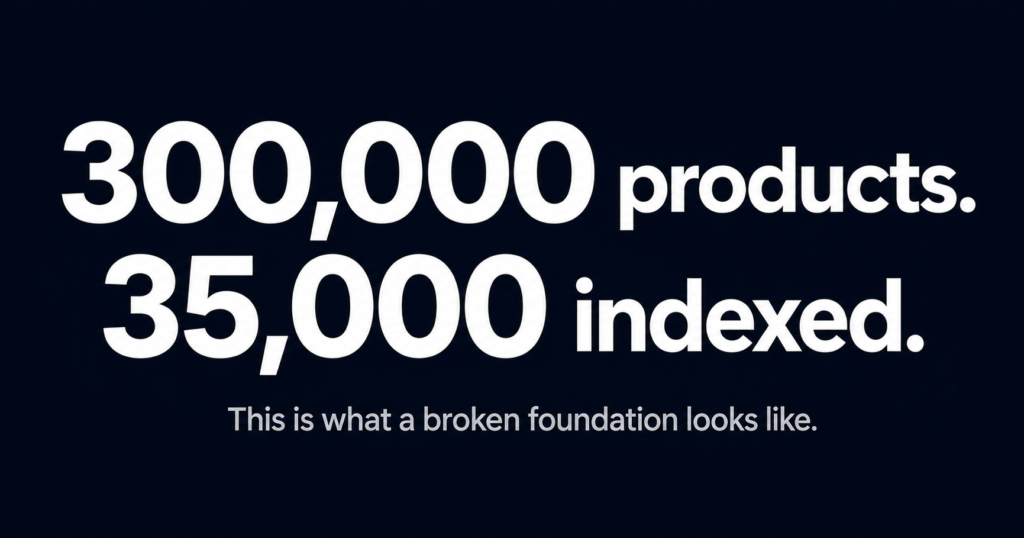
- An unindexed catalog is invisible revenue: one industrial parts supplier had ~300,000 products on its site, but Google had indexed only 35,000. The rest generated zero organic traffic.
- Automation can’t run without a working data pipeline: a pet products retailer had a large email list but no behavioral data syncing from its e-commerce platform, so it had no post-purchase, replenishment or abandoned cart flows.
- The structural fix is the highest-ROI stage, and the one most founders skip: repairing architecture, data pipelines and platform issues takes 8–12 weeks and produces no flashy metrics.
- Fixing first compounds: a 3-month structural fix at Stage 1 delivers more growth than 12 months of execution on a broken base.
Two Examples. Same Pattern.
Founder 1 — Industrial parts supplier. ~300,000 products on their site. Google had indexed 35,000. The rest: invisible, generating zero organic traffic. Six months of incremental fixes later, impressions climbed to 96,000 and clicks hit 7,000/month. Progress — but if we’d fixed the architecture in month one, those same six months of compounding would have produced 400–500k impressions. That gap doesn’t come back. It’s what I call the cost of inaction: the revenue a stalled site loses while nobody is measuring it.
Founder 2 — Pet products retailer (operating in a $24B+ market). Large email list. No behavioral data syncing from the ecommerce platform into their marketing tools. Every campaign was manual and generic. No post-purchase flows. No replenishment triggers. No abandoned cart sequences. The list existed. The automation didn’t — because the data pipeline was broken. It’s one of the seven root causes I find when marketing automation stops working: tools that don’t actually talk to each other.
Both founders were growing. Both were operating well below their ceiling. Neither knew it.
The 4 Stages
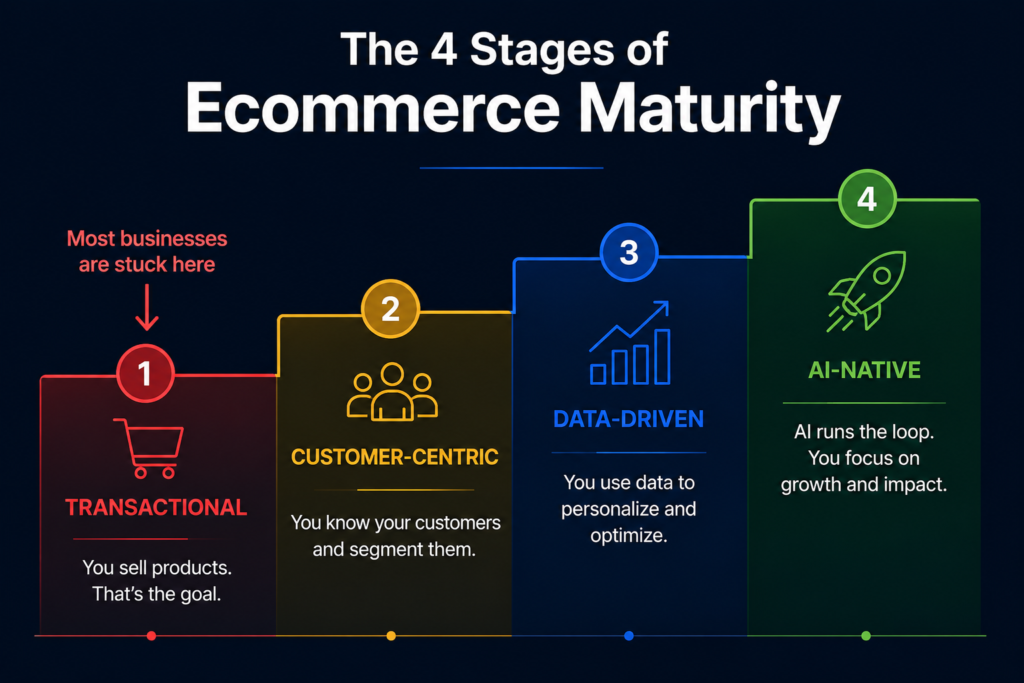
Stage 1 — Broken Foundation Catalog not fully indexed. Customer data not syncing. Channels in silos. The business runs, but every marketing effort hits a ceiling nobody can explain. At industry scale, it’s why $1 trillion is sitting on a broken data foundation.
Stage 2 — Structural Fix Architecture, data pipelines, platform issues — repaired. Takes 8–12 weeks. No flashy metrics. Highest ROI of anything you’ll do. Most founders skip it. On the site side, this is the work The C.R.A.W.L. Audit maps out, starting with crawl efficiency and logical structure.
Stage 3 — Channel Activation Email automation running on live behavioral data. Full catalog indexed. Paid with clean attribution. For the first time, top-of-funnel and retention are actually connected.
Stage 4 — Compounding Growth Every channel feeds every other. Organic grows passively. LTV rises. CAC drops. This is where 10x lives — and it’s built on what happened in Stage 2.
The Hard Part
The reason founders stay at Stage 1 is simple: the business is still moving. Revenue is coming in. Some metrics are up. Stopping to fix infrastructure feels like going backwards.
It isn’t. It’s the only investment that makes every future campaign worth more.
A 3-month structural fix at Stage 1 delivers more growth than 12 months of execution on a broken base. The compounding math is undefeated.
It’s the same blind spot I wrote about in Why Your Business Is Bleeding Revenue — And It’s Not What You Think: when revenue keeps coming in, nobody asks what isn’t covered.
At a Glance: The 4 Stages of E-Commerce Growth
| Stage | What it looks like | What it means for growth |
|---|---|---|
| 1. Broken Foundation | Catalog not fully indexed, customer data not syncing, channels in silos | Every marketing effort hits a ceiling nobody can explain |
| 2. Structural Fix | Architecture, data pipelines and platform issues repaired over 8–12 weeks | No flashy metrics, but the highest ROI of anything you’ll do |
| 3. Channel Activation | Email automation on live behavioral data, full catalog indexed, paid with clean attribution | Top-of-funnel and retention are connected for the first time |
| 4. Compounding Growth | Every channel feeds every other | Organic grows passively, LTV rises, CAC drops |
Where Are You?
Ask yourself:
- What % of your catalog is actually indexed?
- Is customer purchase data syncing in real time to your marketing tools?
- Do you have automated journeys — not newsletters, journeys — between acquisition and first purchase?
- Is there a retention flow between first and second purchase?
Two or more “no” answers: you’re at Stage 1.
The campaign won’t fix it. Fix the foundation first.
Frequently Asked Questions
Usually not because of bad strategy. They’re building on a broken foundation, and revenue keeps coming in just enough to hide it. The business runs, but every marketing effort hits a ceiling nobody can explain.
Three signs: the catalog isn’t fully indexed, customer data isn’t syncing into the marketing tools, and channels run in silos. One supplier I worked with had ~300,000 products, but only 35,000 were indexed. A retailer had a large email list, but with no behavioral data flowing in, every campaign was manual and generic.
Typically 8–12 weeks to repair the architecture, data pipelines and platform issues. It produces no flashy metrics, but it’s the highest-ROI work you’ll do.
Because the business is still moving. Revenue is coming in, some metrics are up, and stopping to fix infrastructure feels like going backwards. It isn’t. It’s the only investment that makes every future campaign worth more.
Channels can finally be activated properly: email automation runs on live behavioral data, the full catalog is indexed, and paid runs with clean attribution. From there, every channel feeds every other. Organic grows passively, LTV rises and CAC drops.
Ask four questions. What % of your catalog is actually indexed? Is customer purchase data syncing in real time to your marketing tools? Do you have automated journeys between acquisition and first purchase? Is there a retention flow between first and second purchase? Two or more “no” answers means you’re at Stage 1.
I work with ecommerce businesses to find where the growth ceiling actually is — and what it takes to break through it.
By PS Harish
10 August 2026Comments
No comments yet.


Leave A Comment