“But we already spent a fortune building it.”
I’ve heard this response more times than I can count.
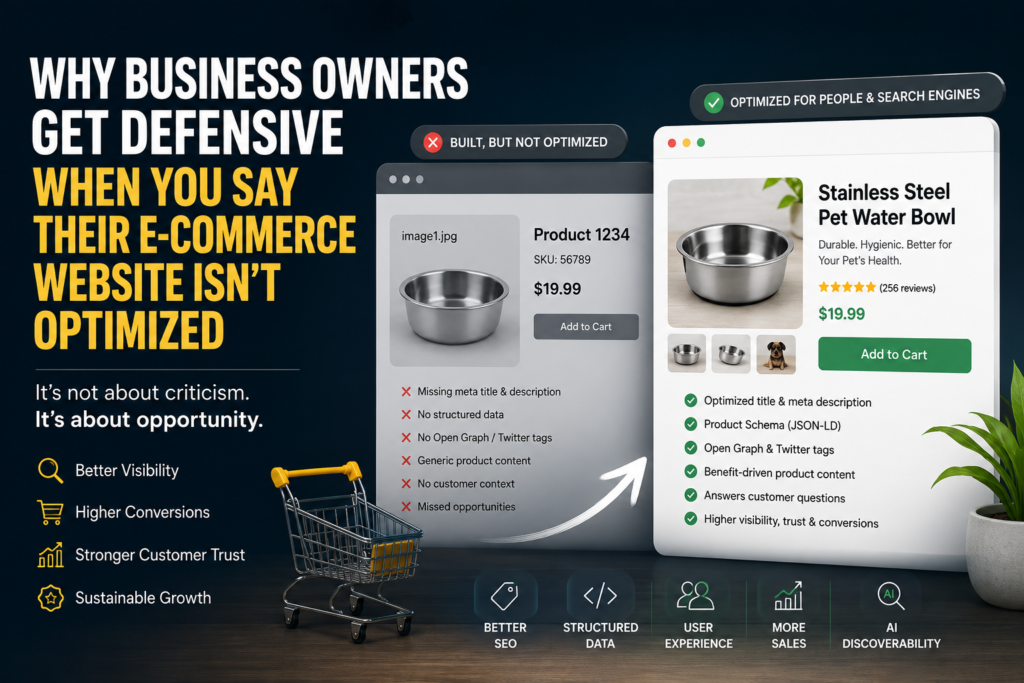
I’ll review an e-commerce website and point out a few observations:
- Product images are named
image1.jpginstead of descriptive filenames. - Product pages don’t include meaningful title tags or meta descriptions.
- There’s no Product Schema or structured data.
- Open Graph and Twitter metadata are missing.
- Product pages tell visitors what the product is—but not why they should buy it.
- Category pages have little or no supporting content.
- Internal linking is minimal.
- Product descriptions are copied directly from the manufacturer.
These aren’t one-off mistakes — they’re the same patterns that kept showing up across ten different DTC brands, the ones I broke down in 10 Reasons DTC and E-Commerce Brands Fail.
Key Takeaways
- Launching a website and optimizing it are two different phases — a site that loads, shows products, and takes payments is “operational,” not optimized.
- Technical optimization covers what most sites skip: title tags, meta descriptions, Product Schema (JSON-LD), Open Graph and Twitter metadata, canonical URLs, clean filenames, and descriptive alt text.
- Content optimization means explaining why a product matters — benefits, use cases, comparisons, FAQs — not just restating manufacturer copy.
- The defensiveness owners feel isn’t disagreement with the fixes — it’s hearing “you did a bad job” when the real message is “there’s more room to grow.”
- Optimization has no finish line: search visibility, product page engagement, conversion rate, average order value, and AI discoverability are ongoing levers, not one-time boxes to check.
Then I’ll say:
“This website hasn’t really been optimized yet.”
The response?
Silence.
Or worse…
“We’ve already invested a lot in this website.”
That’s when I realized the conversation wasn’t about SEO anymore. It was about perception.
A Website Can Be Finished Without Being Optimized
One of the biggest misconceptions in digital commerce is believing that launching a website means the work is complete.
Building a website and optimizing a website are two completely different phases.
Think of buying a new car.
It comes with an engine, seats, tires, and a steering wheel. It works perfectly.
But would anyone call it a race car?
Of course not.
Performance comes from tuning, testing, refining, and continuous improvement.
The same applies to an e-commerce website.
What Most Businesses Call “Optimization”
Many businesses believe optimization means:
- The website loads.
- Products are visible.
- Customers can place orders.
- Payments work.
- Google has indexed a few pages.
Technically, the website is operational.
But operational doesn’t mean optimized.
What Optimization Actually Looks Like
A truly optimized product page goes far beyond displaying a product and its price.
It answers questions for both search engines and customers.
At a Glance: Finished vs. Optimized
| Finished website | Optimized website |
|---|---|
| Site loads, products visible, orders and payments work | Descriptive title tags and meta descriptions on every product page |
Generic filenames (image1.jpg) | Clean, descriptive filenames and alt text |
| No structured data | Product Schema (JSON-LD), Open Graph, Twitter Cards, canonical URLs |
| Manufacturer copy pasted in as-is | Copy written to explain why the product matters, not just what it is |
| Minimal or no internal linking | Deliberate linking between related product and category pages |
| Built for a launch date | Built for search engines, AI answer engines, and customers — continuously |
Technical Optimization
- Optimized title tags
- Compelling meta descriptions
- Product Schema (JSON-LD)
- Open Graph metadata
- Twitter Cards
- Canonical URLs
- Clean image filenames
- Descriptive alt text
Content Optimization
Instead of saying:
Stainless Steel Water Bowl
Explain:
- Why it’s better than plastic.
- Which pets it’s designed for.
- How it solves a problem.
- What benefits customers will experience.
- Frequently asked questions.
- Care instructions.
- Comparison with similar products.
You’re not just selling a product.
You’re answering the questions customers haven’t asked yet.
The Missing Layer: Context
One thing I see repeatedly is product pages that describe features but never explain value.
Features tell people what the product has.
Context tells people why it matters.
Instead of:
- Made with natural ingredients
Explain:
- Gentle enough for sensitive skin.
- Suitable for daily use.
- Free from harsh chemicals.
- Recommended for puppies, seniors, and pets with allergies.
That context helps both customers and modern search engines better understand the product.
Why People Get Defensive
Interestingly, people rarely argue with the individual recommendations.
They agree that Product Schema would help.
They agree image filenames could be improved.
They agree better product descriptions would increase conversions.
What they react to is the implication behind the phrase:
“Your website isn’t optimized.”
Often, what they hear is:
“You’ve done a bad job.”
Those aren’t the same thing.
Most teams worked hard to launch the website.
What they haven’t had the time, expertise, or resources to do is optimize it continuously.
Building Is a Project. Optimization Is a Process.
Launching a website has a finish line.
Optimization doesn’t.
Every month brings opportunities to improve:
- Search visibility
- Click-through rates
- Product page engagement
- Conversion rates
- Average order value
- Customer trust
- AI discoverability
The best-performing e-commerce brands don’t assume their website is finished. They assume there’s always another improvement to make.
Staying finished-but-not-optimized isn’t neutral, either — it has a running cost, which is the math I walk through in The Cost of Inaction: What Stagnant SEO Costs You.
A Better Way to Have the Conversation
Instead of saying:
“Your website has zero optimization.”
Try saying:
“Your website is built and functional. The next opportunity is optimization.”
It’s a subtle difference.
One sounds like criticism.
The other sounds like a roadmap.
And that’s ultimately what optimization should be—a continuous journey of making the customer experience, search visibility, and business outcomes better over time.
Final Thought
The goal isn’t to prove that a website is “bad.”
The goal is to identify what’s possible.
Every missing title tag, every weak product description, every absent schema, and every unexplained product benefit represents an opportunity—not a failure.
The most successful e-commerce businesses understand one simple truth:
A website launch is the beginning of optimization, not the end of it.
Frequently Asked Questions
Finished means it works — it loads, shows products, and takes payments. Optimized means it’s actively built to be found, understood, and chosen: proper title tags, structured data, content that explains value, and internal linking between related pages.
Title tags, compelling meta descriptions, Product Schema (JSON-LD), Open Graph metadata, Twitter Cards, canonical URLs, clean image filenames, and descriptive alt text.
Explaining why a product matters instead of just what it is — the problem it solves, who it’s for, how it compares to alternatives, care instructions, and answers to the questions customers haven’t asked yet.
Because they rarely disagree with the individual fixes — Product Schema, better filenames, stronger descriptions. What they react to is the implication behind “isn’t optimized,” which often lands as “you did a bad job,” even though building and optimizing are just two different phases of the same project.
No. Search visibility, click-through rates, product page engagement, conversion rates, average order value, customer trust, and AI discoverability are all ongoing levers — the best-performing brands keep working them every month rather than treating launch as the finish line.
Swap “your website has zero optimization” for “your website is built and functional — the next opportunity is optimization.” One sounds like criticism; the other sounds like a roadmap.
By PS Harish
8 July 2026Comments
No comments yet.


Leave A Comment