When sales says “these MQLs are rubbish”, marketing teams usually reach for the scoring model. They add points here, take points away there, and raise the threshold.
Three months later, sales says the same thing.
That’s because scoring can’t fix a lead that should never have been in the system. If a fake email, a student researching a thesis, a competitor or the fourth duplicate of the same person gets into your CRM, every system after that point treats it as real. It gets scored, nurtured, routed and reported on. By the time a salesperson calls it, the damage is done.
The fix is to move the check upstream, to the door.
Junk data rarely looks expensive, because the cost is spread across teams:
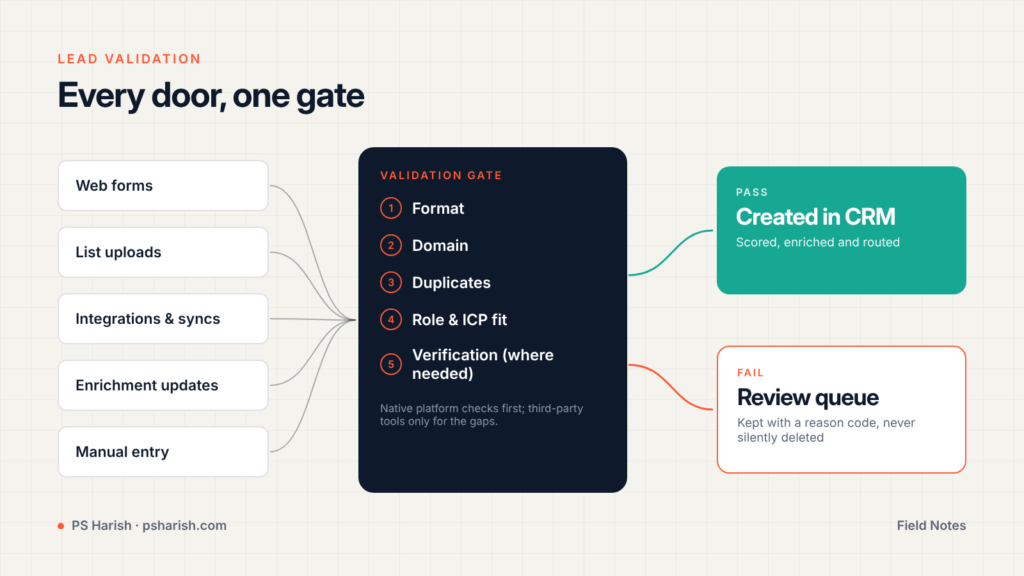
Before building a gate, map every way a record enters your stack. In most B2B setups, it’s some mix of:
Each entry point needs its own rule set. A gate that only covers web forms leaves four other doors open.
A validation gate is a set of checks every new record passes before it’s created or updated as a lead. Records that fail don’t disappear. They go to a review queue with a reason code.
Is the email syntactically valid? Is the phone number in a usable format? Are required fields filled with real values, not “asdf” or “test”?
Is it a business domain or a free email provider? Is it a known disposable domain? Does the domain match the company name given?
For many B2B teams, a free-email lead isn’t rejected outright. It’s routed differently, for example to nurture instead of sales.
Does this person or account already exist? Matching on email alone misses a lot. Use email, name plus company, and domain together, and decide which record wins when two match.
Is this person in a role you sell to? Is the company in your ICP by size, industry and region? Students, job seekers, vendors and competitors are flagged here.
For high-value entry points such as demo requests, add a real-time email verification service. Use it where native checks can’t tell you what you need to know, not everywhere by default. It’s another vendor that will see your data, so it needs the same approvals as any other.
Salesforce, Account Engagement and HubSpot can handle most format, duplicate and required-field rules natively. Start there. Add tools only when a specific gap justifies the cost and the data-sharing approval.
Teams often start with a big cleansing project. That’s backwards. If the door is still open, the database fills up again while you’re cleaning it.
The order that works:
One caution: cleansing and enrichment mean exporting records and often sharing them with a vendor. Get your InfoSec, privacy and data-processing approvals in place before you do. An NDA with the vendor isn’t the same thing.
You can’t improve what you don’t track. Add these to your marketing operations dashboard:
Review the rejection reasons monthly. If one form produces most of the junk, fix the form, not just the filter.
Scoring ranks leads by fit and interest. It assumes the record is real. Validation decides whether the record should exist at all, so it has to come first.
Usually not outright. In many B2B markets, real buyers use personal email on forms. Route them to nurture, enrich where possible, and let behaviour decide.
Mostly, yes. Validation rules, duplicate and matching rules, required fields and Flow cover most checks. Third-party verification fills specific gaps such as mailbox existence.
A basic version covering format, duplicates and domains can go live quickly once the rules are agreed. Agreeing the rules with sales and marketing usually takes longer than building them.
Need a validation gate designed for your stack? It’s one of five workstreams in my MarTech Stack Development service. Also worth reading: Why is my marketing automation not working? 7 root causes.
© 2026 PS Harish