McKinsey calculated the prize. Nobody told companies what’s actually blocking them from claiming it.
The Number That Should Have Changed Everything
In 2021, McKinsey’s Next in Personalization research arrived with a headline that should have triggered a fundamental rethink across every marketing organization: shifting US industries to top-quartile personalization performance would generate over $1 trillion in value.
Five years later, only 15% of companies have achieved cross-channel personalization (StackAdapt, 2026).
The prize is on the table. Most companies can’t pick it up. And the reason isn’t a lack of ambition, budget, or AI tools. The reason is data.
The Foundation Most MarTech Leaders Ignore
When I conduct a MarTech audit, the first question I ask is not “what tools are you using?” It’s a more fundamental one: Do you own your data, or does a platform own it for you?
This distinction determines everything.
An online retailer selling through their own website sees every micro-interaction — which products were viewed, how long a customer spent on a configuration tool, exactly where they abandoned the purchase journey. That behavioral signal is the raw material of personalization. With it, AI can identify that 61% of customers who reach the delivery date selector abandon not because of price, but because lead times exceed six weeks. That’s a supply chain insight surfaced through a personalization lens.
The same retailer selling through a marketplace sees units sold. Nothing else. No session behavior, no configuration interactions, no abandonment signals. AI can’t personalize from a sales report.
This is what I call the Data Visibility Problem — and it’s the primary reason that companies spending significant budgets on personalization tools are generating generic experiences at scale.
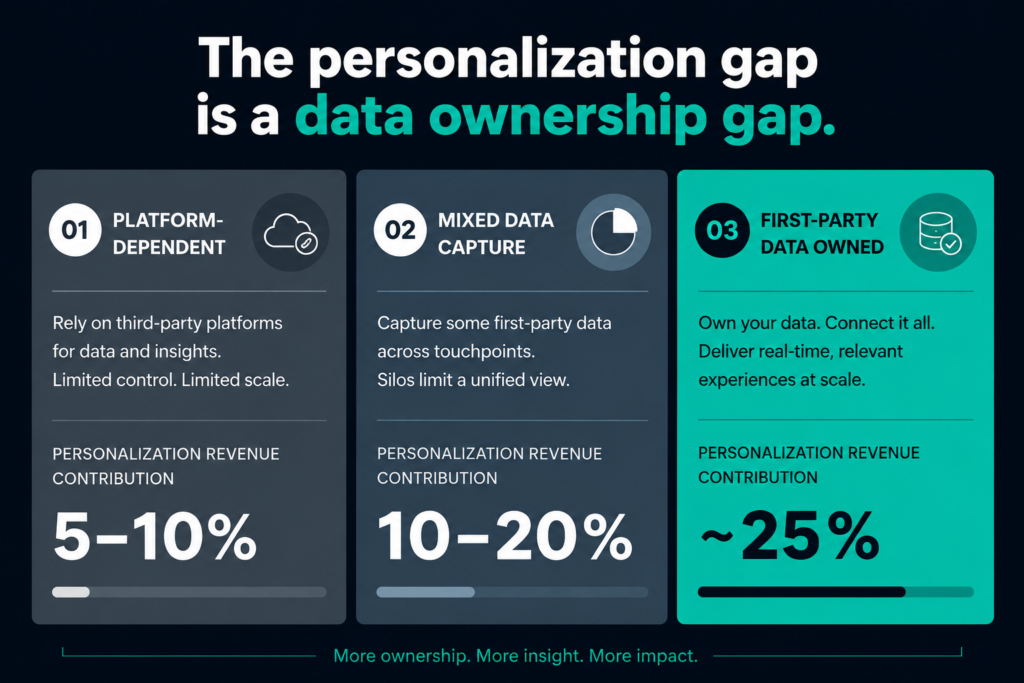
McKinsey’s research confirms the pattern. Companies that generate the most revenue from personalization — digitally native brands with first-party data at the heart of their decision-making — drive approximately 25% of their revenue from personalized activities. Traditional brick-and-mortar companies, with mixed data capture, achieve 10–20%. Companies without direct consumer relationships (CPG brands dependent on retailer data) land at just 5–10%.
The spread isn’t explained by marketing sophistication or AI investment. It’s explained by data ownership and granularity.
What “Clean Data” Actually Means in Practice
Most organizations believe their data problem is a volume problem. They think they need more data. What they actually need is better data — and the ability to act on it in the right timeframe.
Four dimensions determine whether your data foundation can support AI personalization:
Ownership. Does your organization control the primary source of behavioral data, or are you dependent on a third-party platform to decide what you can see? Platform dependency is not a data strategy. It’s a data ceiling.
Granularity. Can your system observe specific micro-actions — time on page, search query sequences, feature usage patterns, configuration tool interactions? Aggregate metrics tell you what happened. Granular behavioral data tells you why — and why is where personalization lives.
Historical depth. AI personalization models require baseline data to identify patterns worth acting on. Without at least 90 days of clean, structured behavioral history, you’re not running a personalization program. You’re running a guess.
Accessibility. Data that exists but is siloed across disconnected systems — CRM here, marketing automation there, product analytics somewhere else — cannot be acted on in real time. Inaccessible data is, from a personalization standpoint, the same as no data.
This is the C in the C.L.E.A.R. framework — Clarity of Data. It’s the first condition that must be true before any AI personalization initiative can succeed, because AI cannot optimize what it cannot observe.
Read the full framework: The C.L.E.A.R. Framework for Pragmatic AI Adoption
The MarTech Stack Trap
There is a specific failure mode I encounter in mid-market and enterprise companies that have invested heavily in MarTech: the thousand-tool problem.
A company has a CRM, a marketing automation platform, a CDP, an analytics suite, a personalization engine, and a data warehouse. Each of these platforms contains valuable customer data. None of them share a consistent customer identifier. The personalization engine is pulling from the marketing automation platform, which is syncing from the CRM on a 24-hour delay, which doesn’t include any of the product behavioral data sitting in the analytics suite.
The AI personalization campaign launches. It fires the right message to the wrong customer segment, three days after the relevant behavior occurred, based on data that was accurate last week.
This isn’t an AI failure. This is a data architecture failure that AI has made more visible.
McKinsey’s research on outperformers is instructive here. Companies that generate the most value from personalization don’t have the most tools — they have the most deliberately designed data infrastructure. They make explicit choices about which customer outcomes to support, and they build their MarTech stack backward from those outcomes, ensuring data flows cleanly to where decisions are made.
What the 2025 Data Adds
McKinsey’s January 2025 Quarterly update raises the stakes further. Their research shows that 65% of customers now cite targeted promotions as a top reason to make a purchase — but only when those promotions are actually targeted, not mass blasts. A North American retailer that rebuilt its data architecture to enable genuine personalization generated $400 million in value from pricing improvements and an additional $150 million from gen AI–enabled targeted offers in a single year. A European telecom that wired its data correctly saw 10% higher engagement from gen AI-personalized messages compared to non-personalized equivalents.
The common thread across every case? The data foundation came first. The AI results followed.
The Audit Before the Investment
Before any organization adds another personalization tool to their stack, I recommend a data clarity audit with four questions:
- Where does your first-party behavioral data live, and who controls access to it?
- How granular is the lowest level of customer interaction you can observe?
- What is the latency between a customer action and your ability to act on that signal?
- Which of your MarTech platforms share a consistent customer identifier — and which don’t?
The answers to these questions will tell you more about your personalization readiness than any vendor demo.
The $1 trillion McKinsey identified isn’t locked behind better AI. It’s locked behind better data foundations. Build the foundation first. The AI compounds on top.
I’ve run this exact data audit — and rebuilt the foundation — across 3 companies. If your personalization stack is underperforming and you suspect data architecture is the reason, I can help as a project consultant or in a full-time role. Connect on LinkedIn or email harish@psharish.com.
By PS Harish
16 August 2026Comments
No comments yet.



Leave A Comment