The technology works. The team doesn’t adopt it. Here’s why — and how to fix it before you launch.
The Graveyard Is Full of Good Pilots
I have seen more AI personalization pilots fail in their second week than in all the weeks that follow combined.
Not because the technology didn’t work. Not because the hypothesis was wrong. Because the people who were supposed to use the system quietly went back to doing things the way they’d always done them — and nobody noticed until the pilot results came back empty.
This is the Change Delta problem. And it kills more AI initiatives than any technical failure ever will. It’s the same pattern behind a bigger one I’ve written about: AI didn’t solve the personalization problem, it exposed it. The failure is operational, not technical.
Key Takeaways
- Pilots die from adoption, not technology: most AI personalization pilots that fail do so in week two, when the people meant to use the system quietly go back to the old way of working, and nobody notices until the results come back empty.
- The Change Delta decides adoption: it’s the gap between how people work today and how the AI expects them to work. Low-delta deployments get adopted. High-delta deployments get abandoned.
- Don’t launch at the highest-ambition use case: full journey orchestration, real-time dynamic pricing and autonomous segment decisioning look great in the board deck, but they’re the use cases most likely to be rejected by the teams who have to live with them.
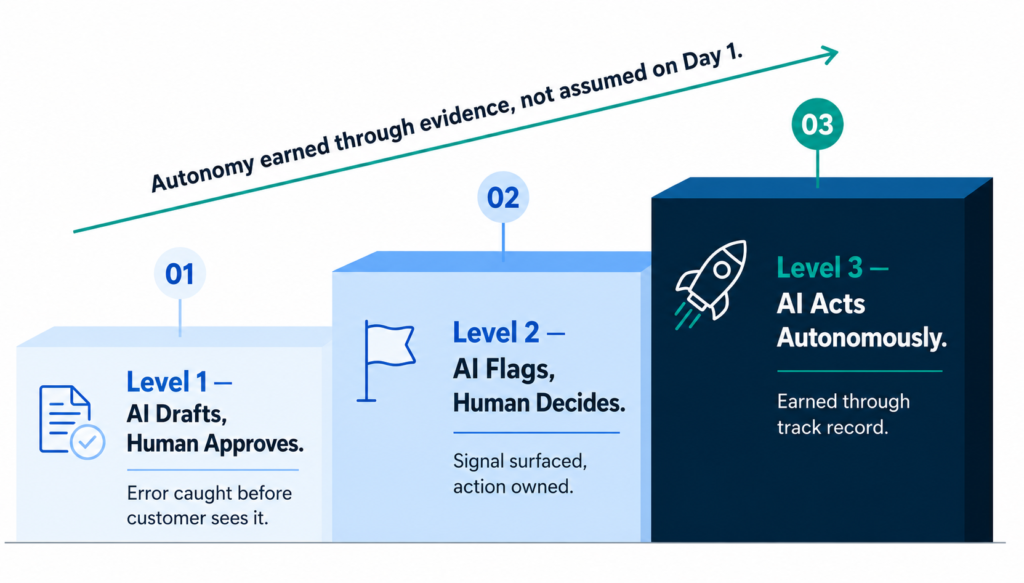
- Start at Level 1 and earn autonomy: move from “AI drafts, human approves” to “AI flags, human decides” to “AI acts autonomously” only as accuracy is proven. This is Autonomy Calibration, the A in the C.L.E.A.R. framework.
- Build the trust mechanism before go-live: override logging, feedback loops and accuracy tracking are the evidence base that earns expanded autonomy. In one real estate rollout, agents went from overriding the AI to trusting it within eight weeks.
Understanding the Change Delta
Every AI personalization initiative creates a gap between how people work today and how the system expects them to work. I call this the Change Delta.
A low Change Delta means the AI slots into an existing workflow — it enhances what people are already doing without requiring them to fundamentally change their behavior. A high Change Delta means the AI requires people to adopt new processes, trust new outputs, and abandon familiar methods. High-delta deployments get abandoned. Low-delta deployments get adopted.
The mistake most organizations make is launching their personalization AI at the highest-ambition, highest-delta use case first. Full journey orchestration. Real-time dynamic pricing. Autonomous segment decisioning. These are the use cases that appear in the pitch deck and the board presentation. They’re also the ones most likely to trigger rejection from the teams who have to live with them.
A sales manager who used to write their own weekly pipeline summary doesn’t automatically trust an AI that writes it for them. A campaign manager who has been building segments manually for five years doesn’t immediately hand that decision to an algorithm. That trust has to be earned — through demonstrated accuracy, through small wins, through a track record built one low-stakes use case at a time.
The Three-Level Risk Framework for Personalization AI
When I work with organizations on personalization deployments, I categorize use cases by autonomy level — the degree to which the AI is acting without human review.
Level 1 — AI Drafts, Human Approves. The AI generates a recommendation, a content variant, or a customer segment. A human reviews and sends. If the AI gets it wrong, the human catches it before it reaches the customer. Change Delta: low. Adoption risk: minimal.
Example: AI generates personalized follow-up sequences for a real estate team based on property viewing behavior. The agent reviews and sends. A wrong recommendation is caught in two seconds. Nothing reaches the buyer.
Level 2 — AI Flags, Human Decides. The AI identifies patterns and surfaces them for human action — unusual churn signals, high-value customers showing disengagement, campaign performance anomalies. The human decides what to do with the signal. If the AI misreads the data, the human corrects course before acting.
Example: AI flags a B2B SaaS trial user who connected their analytics integration but hasn’t generated a report in 72 hours — a known churn indicator. The customer success manager sees the flag and makes the call. (If trial activation is where your churn shows up, I cover how to instrument signals like this in A Frictionless Onboarding Playbook.)
Level 3 — AI Acts Autonomously. The AI makes decisions and executes without human review. This is where personalization delivers its highest scale — and its highest risk. A wrong autonomous decision reaches customers before anyone can stop it.
Example: AI auto-approves personalized offers above a certain value threshold for a high-LTV segment. One misconfigured model parameter and the wrong offer goes to the wrong segment at scale.
The rule I apply in every engagement: start at Level 1. Earn the right to move to Level 3 through demonstrated accuracy at the levels below.
This is the A in the C.L.E.A.R. framework — Autonomy Calibration. It’s not about being conservative with AI. It’s about building the trust infrastructure that makes scale possible.
Read the full framework: The C.L.E.A.R. Framework for Pragmatic AI Adoption
What This Looks Like in a MarTech Context
The real estate sector is a useful lens here, because it combines high-value, emotionally charged purchase decisions with rich behavioral data and a sales team that is deeply invested in their own judgment.
A real estate company I worked with wanted to personalize the property recommendation experience for returning website visitors. They had the data — viewing history, search behavior, price range filters, location preferences. They had the tool — a recommendation engine with a solid track record in e-commerce. And they had the ambition — full autonomous personalization, no agent involvement.
The pilot launched. The agents ignored the AI recommendations and sent their own. The system had no feedback loop. The data didn’t improve. After three weeks, the pilot was declared a failure.
The second attempt took a different approach. The AI generated three personalized property recommendations per returning visitor. The agent saw the recommendations before they went out, could override with one click, and the override behavior was logged. Within four weeks, agents were overriding less than 20% of recommendations. Within eight weeks, they’d stopped overriding almost entirely — because the AI had proven itself right often enough to be trusted.
Same technology. Same data. Completely different outcome — because the Change Delta was managed correctly.
At a Glance: The Three Autonomy Levels
| Level | How it works | When the AI gets it wrong | Example from this post |
|---|---|---|---|
| Level 1: AI Drafts, Human Approves | AI generates a recommendation, content variant or segment. A human reviews and sends | The human catches it before it reaches the customer. Change Delta low, adoption risk minimal | Personalized follow-up sequences for a real estate team, reviewed by the agent before sending |
| Level 2: AI Flags, Human Decides | AI surfaces patterns (churn signals, disengaging high-value customers, campaign anomalies). A human decides what to do | The human corrects course before acting | A B2B SaaS trial user with no report 72 hours after connecting their analytics integration, flagged for customer success |
| Level 3: AI Acts Autonomously | AI decides and executes without human review. Highest scale, highest risk | A wrong decision reaches customers before anyone can stop it | Auto-approved personalized offers for a high-LTV segment, where one misconfigured parameter sends the wrong offer at scale |
What McKinsey’s 2025 Research Adds
McKinsey’s July 2025 interview with Eli Stein at Cannes Lions is direct on this point. When asked what differentiates companies actually seeing value from AI at scale, his answer wasn’t about technology: “They are rethinking workflows from the ground up; redefining roles to match how marketing gets done with AI; making AI interoperable across systems; and building real capability across teams — not just handing over tools.”
Handing over tools without rethinking workflows is the definition of a high Change Delta deployment. The team gets new tools and is expected to use them like they used the old ones. It doesn’t work. It never has.
How McKinsey’s Outperformers Actually Built Autonomy
McKinsey’s research on personalization leaders reveals something consistent: the companies driving the highest revenue from personalization didn’t start with the most ambitious use cases. They started with the most measurable ones.
Their approach — what McKinsey calls “rapid activation capabilities” — involves deploying AI in test-and-learn cycles, with human oversight built in at every stage. They run hundreds of experiments per year, but each experiment is narrow enough to prove or disprove a specific hypothesis. Autonomy expands as the evidence base grows.
This is the flywheel McKinsey describes: personalization leaders have better customer outcomes because they compound learning faster than their peers. They start narrow, measure precisely, and scale what works. They don’t start with scale and hope precision follows.
The Practical Takeaway
If your AI personalization initiative is failing — or if you’re about to launch one and want to increase the odds of success — ask these questions before you go live:
- What is the Change Delta for the people who have to use this system daily? If the answer is “significant,” start smaller.
- What happens when the AI gets it wrong? If the error is visible to customers before a human can catch it, you’re operating at the wrong autonomy level.
- Do you have a mechanism for building trust? Override logging, feedback loops, accuracy tracking — these aren’t nice-to-haves. They’re the evidence base that earns expanded autonomy.
- What’s the smallest version of this use case that proves the concept? Start there.
The organizations winning with AI personalization didn’t get there by launching big. They got there by starting smart.
Frequently Asked Questions
Usually not because the technology failed or the hypothesis was wrong. They fail because the people who were supposed to use the system quietly go back to doing things the way they always have, and nobody notices until the pilot results come back empty. I call this the Change Delta problem, and it kills more AI initiatives than any technical failure.
It’s the gap between how people work today and how an AI system expects them to work. A low Change Delta means the AI slots into an existing workflow and improves what people already do. A high Change Delta means people have to adopt new processes, trust new outputs and abandon familiar methods. Low-delta deployments get adopted. High-delta deployments get abandoned.
Level 1: AI drafts, human approves. The AI generates a recommendation, variant or segment, and a human reviews it before it goes out. Level 2: AI flags, human decides. The AI surfaces patterns like churn signals or campaign anomalies, and a human decides what to do. Level 3: AI acts autonomously. It decides and executes without review, which delivers the highest scale but also the highest risk, because a wrong decision reaches customers before anyone can stop it.
At Level 1, with the smallest version of the use case that proves the concept. Many organizations launch at the highest-ambition, highest-delta use case first, such as full journey orchestration, real-time dynamic pricing or autonomous segment decisioning. Those are the use cases most likely to be rejected by the teams who have to use them. Earn the right to move to Level 3 through proven accuracy at the levels below.
Build the trust mechanism into the rollout: override logging, feedback loops and accuracy tracking. In one real estate deployment, the first fully autonomous pilot was ignored by agents and declared a failure after three weeks. The second attempt let agents see three AI recommendations per returning visitor and override them with one click, with every override logged. Within four weeks agents were overriding fewer than 20% of recommendations, and within eight weeks they had almost stopped overriding.
It’s the A: Autonomy Calibration. The point isn’t to be conservative with AI. It’s to build the trust infrastructure that makes scale possible. That matches McKinsey’s research on personalization leaders, who start with the most measurable use cases rather than the most ambitious ones and expand autonomy as the evidence grows.
I’ve navigated the Change Delta problem hands-on across 3 personalization implementations — getting teams to actually adopt the systems, not just have them installed. If your AI personalization pilot is stalling, I’m available as a project consultant or open to a full-time role. Connect on LinkedIn or email harish@psharish.com.
By PS Harish
17 August 2026Comments
No comments yet.


Leave A Comment