
Onboarding isn’t a screen. It’s the lever that decides whether a product gets adopted at all.
If onboarding is pathetic, adoption is pathetic — no amount of feature work fixes that afterward. If onboarding is smooth, the product finally gets a fair chance to prove itself. I’ve come to believe this is the single highest-leverage thing a product or growth team can spend time on, and I don’t say that as a general opinion. I’ve watched it play out the same way across more than one product, including one I helped build myself.
Here’s the pattern, and it’s a lot more common than any one company likes to admit.
Key Takeaways
- Onboarding is the single highest-leverage lever for adoption — if it’s broken, no amount of feature work afterward fixes it.
- Onboarding friction is almost never one bad decision. It’s usually several individually reasonable requirements — email verification, mobile verification, self-registration, invite-only — stacked by different people who never see the total wall they’ve built.
- Independent research backs the same failure modes: Samuel Hulick (useronboard.com) argues onboarding should be judged by whether it helps the user succeed, not by how thorough the tour is; Appcues flags front-loading every requirement on day one, running one identical flow for every user type, and treating onboarding as a one-time build instead of an ongoing system.
- A healthy SaaS onboarding flow completes at 60–85%. Below that, it’s an onboarding problem, not a product problem — and it’s usually invisible, because nobody’s dashboard has a line item called “onboarding.”
- The fix isn’t removing the checks — fraud and spam are real. It’s timing: let people see the product first, then verify identity in the background once they already have a reason to stay logged in.
The case
On the platform I’m thinking of — an AI product I was closely involved in building — a new user has two ways in: someone invites them, or they self-register. At registration, there are multiple signup options to choose from. And before they can do anything with the product, two things have to happen: their email gets validated, and their mobile number gets validated.
Both. Required. Before login.
None of that reads as unreasonable in a spec document. It reads like due diligence. And that’s exactly the trap.
Nobody chose this
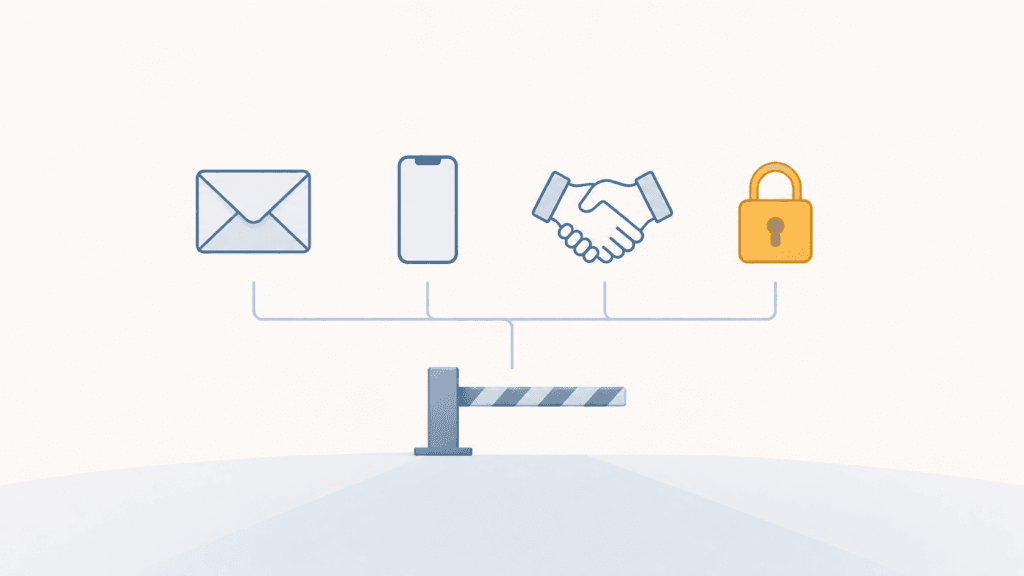
Here’s what actually happened, and I’d bet it’s what happened at your company too.
Someone decided email verification was necessary — it keeps spam accounts out, and it’s practically free to justify. Someone else, usually the founder, insisted on mobile verification — it’s a stronger trust and fraud signal, and in a product handling anything sensitive, that instinct isn’t wrong. Self-registration got added because gating everything behind an invite kills growth. Invite-only stayed in place alongside it because enterprise buyers want control over who gets in.
Four decisions. Every single one defensible in the room where it got made. It’s the same shape behind a lot of the product-killing patterns I’ve catalogued elsewhere — decisions that look completely fine in isolation and only turn into a failure once they stack. See Why Great Startups Stall: 5 Patterns That Kill Products.
Nobody sat down and designed a wall. What they built, one reasonable requirement at a time, was a wall anyway — and a new user has to clear all of it before they’ve done a single thing with the product they signed up for.
That’s the part worth sitting with. Onboarding friction is almost never one bad decision. It’s several good ones, made by different people, at different times, none of whom saw the total.
This isn’t a one-off pattern
I want to be clear this isn’t a complaint about one product. It’s the same shape I’ve seen show up on more than one thing I’ve worked on, and it matches what the better-known onboarding research keeps finding.
Samuel Hulick, who’s spent years studying this at useronboard.com, makes the point plainly in his conversation with Intercom: onboarding should be judged by whether it helps someone succeed at what they came to do, not by how thorough the tour is. A flow built around institutional needs — verification, compliance, growth mechanics — instead of the user’s first goal is optimizing for the wrong side of the transaction.
Appcues’ research lands on the same failure modes from a different angle. The bad patterns they flag show up almost everywhere once you know to look for them: front-loading every requirement on day one instead of spreading it across sessions, running one identical flow for every user type regardless of role or intent, and treating onboarding as a single event to survive rather than a system to keep improving.
Every one of those was present in the case above. Verification front-loaded. One flow for everyone, whether they were invited by a teammate or arrived cold. Built once, rarely revisited.

What it costs
Appcues puts a number on what “good” looks like: a healthy SaaS onboarding flow should see somewhere between 60% and 85% completion. Below that, you’re not looking at a product problem, you’re looking at an onboarding problem — and it’s usually invisible, because nobody’s dashboard has a line item called “onboarding,” they just see softer signup and activation numbers and assume the market is the issue.
Every gate before value is a tax on activation. Two identity checks before a user has touched the product isn’t security, from the user’s point of view — it’s two more chances to close the tab. And the two decision-makers who each added a requirement will never be in the same room comparing notes on what the combined drop-off looks like, because nobody owns the total. That’s the same failure shape I’ve seen in other systems that quietly accumulate cost nobody’s tracking end-to-end. I’ve catalogued the same pattern in CRM data — a bill that keeps growing precisely because no single owner ever sees the whole thing. See What Bad CRM Data Really Costs.
The fix, previewed
The good news is the fix isn’t “remove the checks.” Fraud and spam are real. The fix is timing.
Identity verification doesn’t have to be a gate before entry. It can run after — in the background, once the user already has a reason to stay logged in. Let people see the product first. Verify the account while they’re already inside it.
That’s the shift the next post is built around: what a genuinely frictionless entry looks like, how gamification earns its place once the friction is gone, and how to actually measure whether any of it is working instead of guessing.
If your onboarding has more than one “reasonable” requirement stacked in front of the first thing a user actually wants to do, it’s worth counting them. It’s a more honest audit than most onboarding reviews I’ve seen.
At a Glance: The Four Decisions That Built the Wall
| Requirement | Who added it | Why it seemed reasonable |
|---|---|---|
| Email verification | A team member | Keeps spam accounts out, cheap to justify |
| Mobile verification | The founder | Stronger trust/fraud signal for a sensitive product |
| Self-registration | Growth/product | Gating everything behind invites kills growth |
| Invite-only (kept alongside) | Enterprise/sales | Enterprise buyers want control over who gets in |
Frequently Asked Questions
Because it’s built one reasonable requirement at a time by different people, at different times, none of whom see the total. Four individually defensible decisions — email verification, mobile verification, self-registration, invite-only — add up to a wall nobody actually designed.
Somewhere between 60% and 85%, per Appcues’ research. Below that, you’re looking at an onboarding problem, not a product problem — and it’s usually invisible, because nobody’s dashboard has a line item called “onboarding.”
No. Fraud and spam are real problems. The fix is timing: identity verification doesn’t have to be a gate before entry — it can run in the background after the user already has a reason to stay logged in.
Because if onboarding is broken, no amount of downstream feature work fixes it — the product never gets a fair chance to prove itself. If onboarding is smooth, that’s when the product actually gets tested on its merits.
Count the “reasonable” requirements stacked in front of the first thing a user actually wants to do. If there’s more than one, it’s worth auditing — that’s a more honest check than most onboarding reviews.
About the author
I’m Harish. I spend a lot of my working life around product onboarding and activation — designing it, auditing it, and pulling apart the flows that quietly cost products their users before anyone notices.
I’m open to new work at the moment. That covers product management and product leadership roles, and shorter projects I can take up on the side — an onboarding audit, an activation review, a hands-on fix for a signup flow that isn’t converting.
If you read this and recognized your own onboarding in it, I’d be glad to hear about it. harish@psharish.com
By PS Harish
31 August 2026Comments
No comments yet.


Leave A Comment