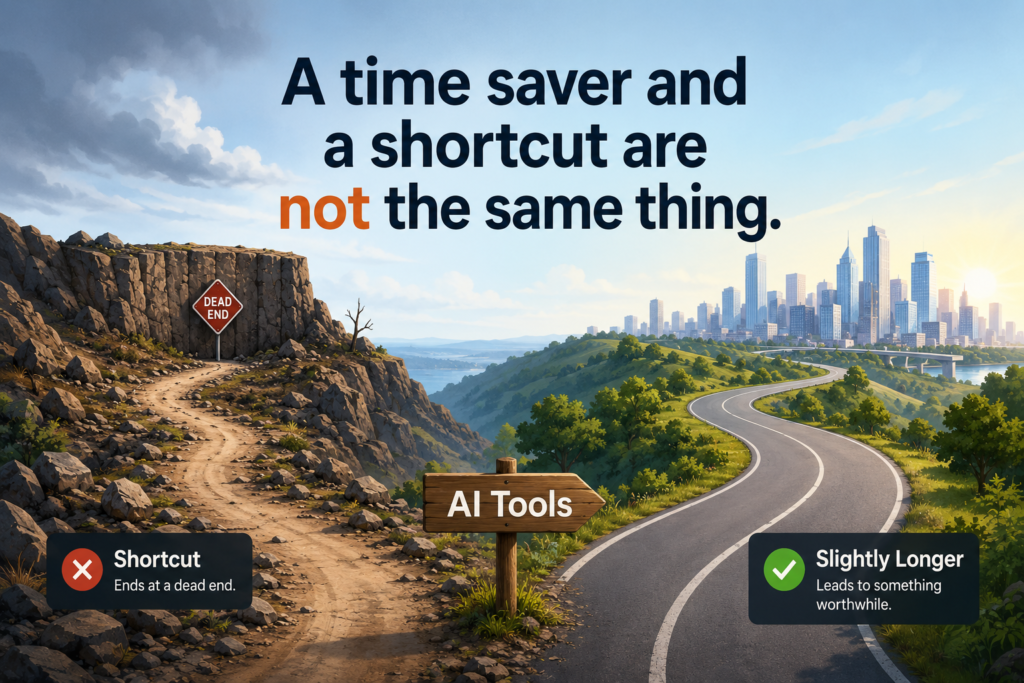
In short: AI coding tools genuinely accelerate development — a skilled developer can compress a week of work into a day. But using AI output as production-ready code, without engineering discipline behind it, creates compounding technical debt. The teams winning with AI use it to accelerate good processes, not replace them.
AI Is One of the Best Things to Happen to Software Development
Let’s start there, because that’s the truth.
AI coding tools have genuinely changed what’s possible. A good developer using AI can produce in a day what used to take a week. Prototypes that once required a full sprint can now be validated in hours. Ideas that lived in someone’s head can be visualized before a single meeting.
This is real. And it matters.
But there’s a distinction that’s getting lost in the excitement — and it’s costing teams more than they realize.
There is a difference between using AI to save time and using AI to skip the work.
What Vibe Coding Tools Are Actually Doing
Tools like Lovable, Cursor, Replit AI, and similar platforms are exceptional at one thing: turning a description into a functioning prototype fast.
What they are not doing behind the scenes:
- Mapping your data dependencies
- Enforcing security boundaries
- Applying SOLID principles to your codebase
- Understanding how this feature will interact with the next one you add
- Planning for what happens when 10,000 users hit it at once
The AI generates code that works for the scenario it was given. It has no memory of last week’s decisions. It has no awareness of your broader system. It’s optimizing for “this prompt works” — not “this product scales.”
That’s not a flaw in the tools. It’s simply what they are. The mistake is treating prototype output as a production foundation.
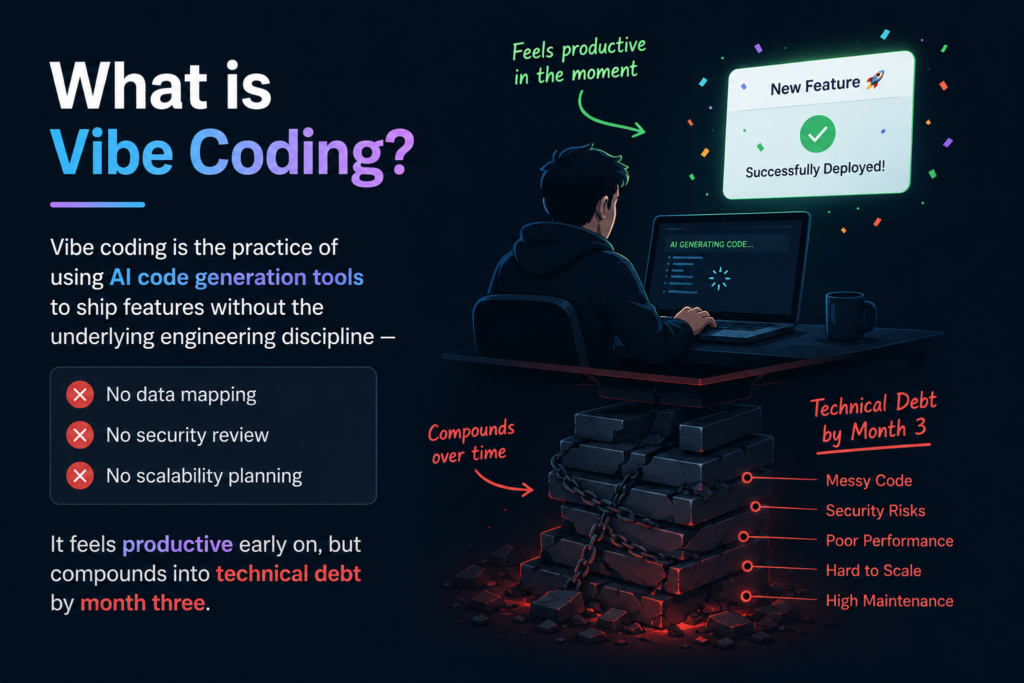
What is Vibe Coding?
Vibe coding is the practice of using AI code generation tools to ship features without the underlying engineering discipline — no data mapping, no security review, no scalability planning. It feels productive early on, but compounds into technical debt by month three.
The Pattern That Plays Out
Here’s what I’ve seen repeatedly with teams that build entirely inside vibe-coding tools:
Month 1: Everything works. The demo is smooth. The MVP is live. Everyone is excited.
Month 2: Features start conflicting. A new addition breaks something that worked before. The codebase becomes hard to navigate. Security gaps surface — exposed API keys, missing auth checks, unvalidated inputs. Data behaves inconsistently. The team shifts from building to firefighting.
Month 3: Someone says “we need to rewrite this.”
This happens not because AI is bad, but because the engineering discipline that should have run alongside the AI was skipped entirely. The speed was real. The shortcuts were real too — and they compound.
| Month 1 (Vibe Coding) | Month 3 (Vibe Coding) | Month 1 (AI + Engineering) | |
|---|---|---|---|
| Speed | ⚡ Fast | 🐢 Slowing down | ⚡ Fast |
| Feature conflicts | None | Increasing | Minimal |
| Security posture | Unknown | Gaps emerging | Reviewed |
| Technical debt | Low | High | Managed |
The Real Cost of “Shipping Fast”
There’s a phrase that captures this well:
“Quick is forgotten. Dirty stays.”
The speed of shipping gets celebrated for a week. The technical debt lives in your codebase for months or years. Every developer you bring on has to work around it. Every new feature has to navigate it. Every bug takes twice as long to trace because the architecture wasn’t designed — it was generated.
This is what happens when AI is treated as a shortcut rather than a tool. The time you “saved” upfront gets paid back — with interest — in maintenance, rewrites, and lost trust from users who experience the gaps.
The Right Way to Use AI in Product Development
AI should make your engineering process faster — not replace it.
Here’s how that looks in practice:
Use AI for:
- Validating ideas quickly — does this flow make sense before you commit resources?
- Generating a reference prototype to align stakeholders on direction
- Accelerating development once the architecture and brief are defined
- Automating repetitive coding tasks within a well-structured codebase
Still do the engineering work:
- Write the brief or PRD before any feature gets built
- Map dependencies — what does this feature touch, what breaks if it changes?
- Design the data flow — where does data come from, how is it validated, where does it go?
- Test thoroughly — not just “does it work” but data integrity, edge cases, security, and load
If a stakeholder has prototyped something in Lovable — that’s useful. Use it as a reference for the brief. Then build it properly. The prototype shows the what. Engineering defines the how.
AI Makes Good Developers Faster — That’s the Point
The teams getting the most out of AI tools are not the ones skipping process. They’re the ones who have strong process and are using AI to accelerate within it.
They write better briefs faster. They generate boilerplate in seconds. They validate architecture decisions before committing. They use AI to enhance every stage of their PDLC — not to bypass it.
That’s the time saving. That’s the real value.
The shortcut version gives you a demo that looks like a product. The disciplined version gives you a product that works like one.
The Bottom Line
AI is one of the most powerful tools available to product and engineering teams today. The goal isn’t to use it less — it’s to use it in the right places.
Save time on the things AI is genuinely good at. Don’t skip the thinking, the planning, and the structure that make a product hold up.
AI saves time. Engineers make it reliable. You need both. The same principle applies to content teams too — AI should accelerate your process, not replace it. Here’s what that looks like at scale.
Frequently Asked Questions
Yes — but with structure around it. AI coding tools can compress a week of development work into a single day when used correctly. The key is using AI to accelerate your existing engineering process, not replace it. Teams that see the best results use AI for idea validation, boilerplate generation, and prototyping — while keeping human review in place for security, data mapping, and system integration.
AI-assisted development means using AI tools within a structured engineering workflow — with proper briefs, dependency mapping, code review, and testing still in place. Vibe coding means using AI to generate and ship code without those guardrails. The output looks the same in week one. By month three, vibe-coded projects typically show feature conflicts, security gaps, and inconsistent data handling because the foundational engineering discipline was skipped.
AI itself doesn’t create technical debt — skipping engineering discipline does. When teams treat AI-generated code as production-ready without review, they accumulate hidden problems: unreviewed security assumptions, no scalability planning, poor data flow design. The pattern is predictable: fast progress early, compounding problems later. AI used within a proper engineering framework actually reduces technical debt by accelerating the parts that don’t require deep thinking, freeing engineers to focus on the parts that do.
Keep your engineering fundamentals in place and let AI work within them, not around them. Practically this means: write the brief before you prompt, map your data flows before you generate, review AI output the same way you’d review a junior developer’s pull request, and never skip testing because the code “looks right.” The teams doing this well treat AI output as a first draft, not a final product.
Because the problems AI creates aren’t visible immediately. A vibe-coded project ships fast and appears functional — but it was built without security enforcement, scalability planning, or system integration design. These gaps don’t show up on day one. They surface when you try to add the next feature, when traffic increases, or when you need to connect the system to something else. By that point, the cost of fixing the foundation is often higher than rebuilding it properly from the start.
I’m currently exploring senior AI product and engineering roles where this kind of thinking drives how the team builds. If that’s your organization, I’d love to connect.
By PS Harish
24 July 2026Comments
No comments yet.



Leave A Comment